
|
You entered: galaxies
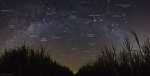 A Starry Night in Brazil
9.05.2009
This panoramic image tracing constellations in the southern sky shows off a beautiful vista toward the center of our Milky Way Galaxy. It was recorded just last month near the city of Campos in northeastern Rio de Janeiro state, Brazil.
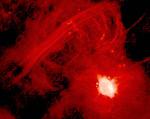 The Galactic Center Radio Arc
21.05.2002
What causes this unusual structure near the center of our Galaxy? The long parallel rays slanting across the top of the above radio image are known collectively as the Galactic Center Radio Arc and jut straight out from the Galactic plane.
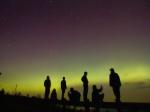 Contemplating the Sky
13.08.2002
Have you contemplated your sky recently? Last night was a good one for midnight meditators at many northerly locations as meteors from the Perseid meteor shower frequently streaked through. The Perseid meteor shower has slowly been building to a crescendo but should continue to be rewarding tonight and into the week.
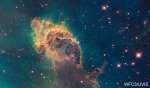 Carina Nebula Dust Pillar
7.02.2015
This cosmic pillar of gas and dust is nearly two light-years wide. The structure lies within one of our galaxy's largest star forming regions, the Carina Nebula, shining in southern skies at a distance of about 7,500 light-years.
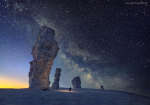 The Milky Way over the Seven Strong Men Rock Formations
3.04.2018
You may have heard of the Seven Sisters in the sky, but have you heard about the Seven Strong Men on the ground? Located just west of the Ural Mountains, the unusual Manpupuner rock formations are one of the Seven Wonders of Russia. How these ancient 40-meter high pillars formed is yet unknown.
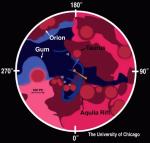 The Solar Neighborhood
25.02.1998
You are here. The orange dot in the above false-color drawing represents the current location of the Sun among local gas clouds in the spiral Milky Way Galaxy. These gas clouds are so thin that we usually see right through them. Nearly spherical bubbles surround regions of recent star formation.
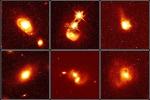 A Quasar Portrait Gallery
6.12.1997
QUASARs (QUASi-stellAR objects) lie near the edge of the observable Universe. Discovered in 1963, astronomers were astounded that such objects could be visible across billions of light-years, as this implies they must emit prodigious amounts of energy. Where does the energy come from?
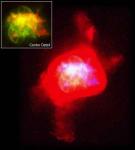 NGC 6210: The Turtle in Space Planetary Nebula
28.10.1998
A Turtle in Space? Planetary nebula NGC 6210 may look like a giant space turtle, but it is actually much more massive and violent. Fortunately, this gas cloud in Hercules lies about 6500 light years away.
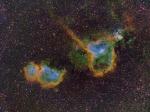 The Heart and Soul Nebulas
10.08.2005
Is the heart and soul of our Galaxy located in Cassiopeia? Possibly not, but that is where two bright emission nebulas nicknamed Heart and Soul can be found. The Heart Nebula, officially dubbed IC 1805 and visible above on the right, has a shape reminiscent of a classical heart symbol.
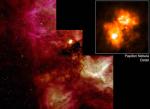 N159 and the Papillon Nebula
14.06.1999
In a search for massive stars, the Hubble Space Telescope has peered into yet another spectacular region of star formation. This nebula, known as N159, spans over 150 light-years and is located in the neighboring Large Magellanic Cloud galaxy, about 170,000 light years distant.
|
January February March April May June July August September October |
|||||||||||||||||||||||||||||||||||||||||||||||||