
|
You entered: nebula
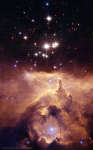 NGC 6357: Cathedral to Massive Stars
30.08.2020
How massive can a normal star be? Estimates made from distance, brightness and standard solar models had given one star in the open cluster Pismis 24 over 200 times the mass of our Sun, making it one of the most massive stars known.
 APOD: 2025 February 3 Б Wolf Rayet Star 124: Stellar Wind Machine
3.02.2025
Some stars explode in slow motion. Rare, massive Wolf-Rayet stars are so tumultuous and hot that they are slowly disintegrating right before our telescopes. Glowing gas globs each typically over 30 times more massive than the Earth are being expelled by violent stellar winds.
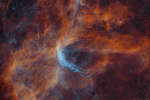 APOD: 2026 May 22 Б The Nebulous Realm of WR 134
22.05.2026
This cosmic snapshot covers a field of view over twice as wide as the full Moon within the boundaries of the high-flying constellation Cygnus. Made using astronomical narrowband filters, the image highlights the bright edge of a ring-like nebula traced by the glow of ionized hydrogen and oxygen gas.
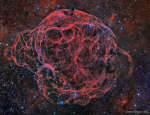 Simeis 147: Supernova Remnant
18.05.2017
It's easy to get lost following intricate filaments in this detailed image of faint supernova remnant Simeis 147. Also cataloged as Sharpless 2-240 it goes by the popular nickname, the Spaghetti Nebula. Seen toward the boundary of the constellations Taurus and Auriga, it covers nearly 3 degrees or 6 full moons on the sky.
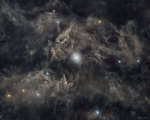 North Star: Polaris and Surrounding Dust
28.04.2021
Why is Polaris called the North Star? First, Polaris is the nearest bright star toward the north spin axis of the Earth. Therefore, as the Earth turns, stars appear to revolve around Polaris, but Polaris itself always stays in the same northerly direction -- making it the North Star.
 Southern Ocean Sky
4.07.2011
Clouds and sky both show illuminating changes during this time lapse video from the south of Australia. In the foreground are scenes visible over a rocky coastline toward the Southern Ocean. Dark clouds flow...
 Twistin' by the Lagoon
23.01.1997
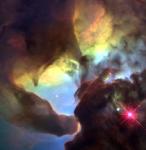
The awesome spectacle of starbirth produces extreme stellar winds and intense energetic starlight -- bombarding dusty molecular clouds inside the Lagoon Nebula (M8). At least two long funnel shaped clouds, each roughly half a light-year long, have apparently been formed by this activity.
 All Sky Milky Way Panorama
25.11.2009
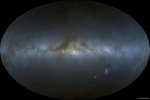
If you could go far away from the Earth and look around the entire sky -- what would you see? Such was the goal of the All-Sky Milky Way Panorama 2.0 project of Axel Mellinger.
 Galaxy Wars: M81 versus M82
3.02.2016
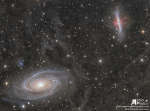
In the lower left corner, surrounded by blue spiral arms, is spiral galaxy M81. In the upper right corner, marked by red gas and dust clouds, is irregular galaxy M82. This stunning vista shows these two mammoth galaxies locked in gravitational combat, as they have been for the past billion years.
 An Immersive Visualization of the Galactic Center
22.01.2018
What if you could look out from the center of our Galaxy -- what might you see? Two scientifically-determined possibilities are shown in the featured video, an immersive 360-degree view which allows you to look around in every direction.
|
January February March April May June July August |
||||||||||||||||||||||||||||||||||||||||||||||||||||||||