
|
You entered: nebula
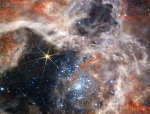 Tarantula Stars R136 from Webb
7.09.2022
Near the center of a nearby star-forming region lies a massive cluster containing some of the largest and hottest stars known. Collectively known as star cluster NGC 2070, these stars are part of the vast Tarantula Nebula and were captured in two kinds of infrared light by the new Webb Space Telescope.
 APOD: 2023 April 11 Б North Star: Polaris and Surrounding Dust
11.04.2023
Why is Polaris called the North Star? First, Polaris is the nearest bright star toward the north spin axis of the Earth. Therefore, as the Earth turns, stars appear to revolve around Polaris, but Polaris itself always stays in the same northerly direction -- making it the North Star.
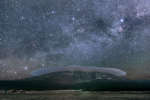 A Protected Night Sky Over Flagstaff
16.04.2008
This sky is protected. Yesterday marked the 50 year anniversary of the first lighting ordinance ever enacted, which restricted searchlight advertisements from sweeping the night skies above Flagstaff, Arizona, USA. Flagstaff now enjoys...
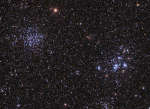 M46 and M47: Star Clusters Young and Old
3.04.2012
Many stars form in clusters. Galactic or open star clusters are relatively young swarms of bright stars born together near the plane of our Milky Way Galaxy. Separated by about a degree...
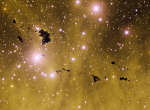 Thackerays Globules
12.06.2012
These are larger dust bunnies than you will find under your bed. Situated in rich star fields and glowing hydrogen gas, these opaque clouds of interstellar dust and gas are so large they might be able to form stars.
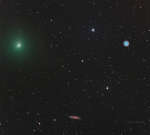 The Comet, the Owl, and the Galaxy
24.03.2017
Comet 41P/Tuttle-Giacobini-Kresak poses for a Messier moment in this telescopic snapshot from March 21. In fact it shares the 1 degree wide field-of-view with two well-known entries in the 18th century comet-hunting astronomer's famous catalog.
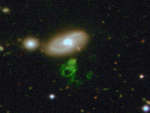 What is Hanny's Voorwerp?
25.06.2008
What is that green thing? A volunteer sky enthusiast surfing through online Galaxy Zoo images has discovered something really strange. The mystery object is unusually green, not of any clear galaxy type, and situated below relatively normal looking spiral galaxy IC 2497.
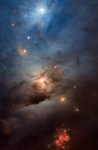 NGC 1333: Stellar Nursery in Perseus
22.04.2023
In visible light NGC 1333 is seen as a reflection nebula, dominated by bluish hues characteristic of starlight reflected by interstellar dust. A mere 1,000 light-years distant toward the heroic constellation Perseus, it lies at the edge of a large, star-forming molecular cloud.
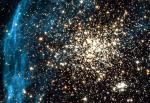 NGC 1850: Not Found in the Milky Way
12.07.2001
A mere 168,000 light-years distant, this large, lovely cluster of stars, NGC 1850, is located near the outskirts of the central bar structure in our neighboring galaxy, the Large Magellanic Cloud. A first...
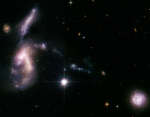 Galaxy Group Hickson 31
22.02.2010
Will the result of these galactic collisions be one big elliptical galaxy? Quite possibly, but not for another billion years. Pictured above, several of the dwarf galaxies of in the Hickson Compact Group 31 are seen slowly merging.
|
January February March April May June July August |
||||||||||||||||||||||||||||||||||||||||||||||||||||||||