
|
You entered: life
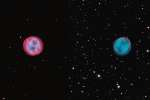 Northern and Southern Owls
6.05.2010
Captured in colorful telescopic portraits, two cosmic owls glare back toward planet Earth in this intriguing comparison of planetary nebulae. On the left is M97 in the constellation Ursa Major, also known in the northern hemisphere as the Owl Nebula.
 DNA: The Molecule that Defines You
21.08.2012
Every living thing on planet Earth is defined by its own molecule -- what's yours? This molecule, called DNA, spans about two meters stretched out but is coiled into every cell in your body.
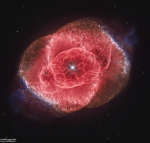 The Cats Eye Nebula from Hubble
30.01.2017
To some, it may look like a cat's eye. The alluring Cat's Eye nebula, however, lies three thousand light-years from Earth across interstellar space. A classic planetary nebula, the Cat's Eye (NGC 6543) represents a final, brief yet glorious phase in the life of a sun-like star.
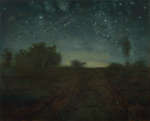 Starry Night by Jean Franцois Millet
13.03.2020
A dramatic nocturnal landscape from around 1850, this oil painting is the work of French artist Jean-Francois Millet. In the dark and atmospheric night sky are shooting stars, known too as meteors, above a landscape showing a path through the faintly lit countryside that leads toward trees and a cart in silhouette on the horizon.
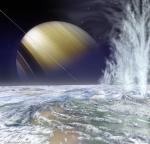 Enceladus Ice Volcanos
8.06.2006
In this stunning Saturnian vista - one in a series of artist's visions of volcanos on alien worlds - icy geysers erupt along narrow fractures in inner moon Enceladus. The majestic plumes were actually discovered by instruments on the Cassini Spacecraft during close encounters with bright and shiny Enceladus last year.
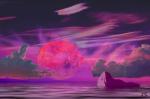 Sunrise from the Surface of Gliese 581c
2.05.2007
How might a sunrise appear on Gliese 581c? One artistic guess is shown above. Gliese 581c is the most Earth-like planet yet discovered and lies a mere 20 light-years distant. The central red dwarf...
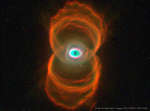 MyCn18: An Hourglass Planetary Nebula
10.05.2015
The sands of time are running out for the central star of this hourglass-shaped planetary nebula. With its nuclear fuel exhausted, this brief, spectacular, closing phase of a Sun-like star's life occurs as its outer layers are ejected - its core becoming a cooling, fading white dwarf.
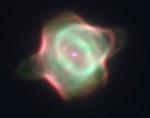 Hen 1357: New Born Nebula
6.10.2001
This Hubble Space Telescope snapshot shows Hen-1357, the youngest known planetary nebula. Graceful, gentle curves and symmetry suggest its popular name - The Stingray Nebula. Observations in the 1970s detected no nebular material, but this image from March 1996 clearly shows the Stingray's emerging bubbles and rings of shocked and ionized gas.
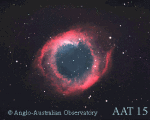 NGC 7293: The Helix Nebula
17.04.1996
The Helix nebula (New General Catalog number 7293) is estimated to be a mere 450 light-years from the Sun, in the direction of the constellation Aquarius. At that distance it may well be the closest planetary nebula, offering a dramatic snapshot of a brief final evolutionary stage in the life of a solar-type star.
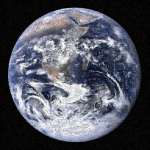 Mosaic: Welcome to Planet Earth
13.07.2010
Welcome to Planet Earth, the third planet from a star named the Sun. The Earth is shaped like a sphere and composed mostly of rock. Over 70 percent of the Earth's surface is water. The planet has a relatively thin atmosphere composed mostly of nitrogen and oxygen.
|
January February March April May June July August September October |
|||||||||||||||||||||||||||||||||||||||||||||||||