
|
You entered: life
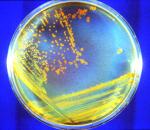 D rad Bacteria: Candidate Astronauts
30.09.2002
These bacteria could survive on another planet. In an Earth lab, Deinococcus radiodurans (D. rad) survive extreme levels of radiation, extreme temperatures, dehydration, and exposure to genotoxic chemicals. Amazingly, they even have the ability to repair their own DNA, usually with 48 hours. Known as an extremophile, bacteria such as D.
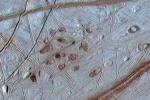 Europa s Freckles
1.11.2002
Europa, one of Jupiter's large Galilean moons, may well posses an ocean of liquid water hidden beneath its icy surface -- and so holds the tantalizing possibility of life. In this image, constructed with...
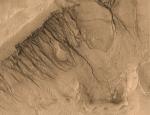 Unusual Gullies and Channels on Mars
5.02.2003
What could have formed these unusual channels? Inside Newton Basin on Mars, numerous narrow channels run from the top down to the floor. The above picture covers a region spanning about 1500 meters across.
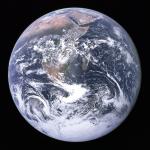 Welcome to Planet Earth
25.03.2007
Welcome to Planet Earth, the third planet from a star named the Sun. The Earth is shaped like a sphere and composed mostly of rock. Over 70 percent of the Earth's surface is water. The planet has a relatively thin atmosphere composed mostly of nitrogen and oxygen.
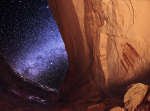 Milky Way Over Ancient Ghost Panel
19.05.2010
Long before Stonehenge was built, well before the Dead Sea Scrolls were written, ancient artists painted life-sized figures on canyon walls in Utah, USA -- but why? Nobody is sure. The entire panel of figures...
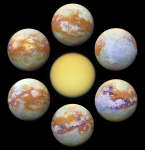 Seeing Titan
20.08.2020
Shrouded in a thick atmosphere, Saturn's largest moon Titan really is hard to see. Small particles suspended in the upper atmosphere cause an almost impenetrable haze, strongly scattering light at visible wavelengths and hiding Titan's surface features from prying eyes.
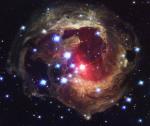 V838 Mon: Light Echo Update
4.02.2005
Expanding light echoes continue to illuminate the dusty environs of V838 Monocerotis, mysterious variable star near the edge of our Galaxy. This stunning image, produced from Hubble data recorded in October of 2004, adds to a unique series of space-based, high-resolution views.
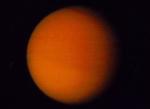 Titan: Saturns Smog Moon
7.02.1999
The largest moon of Saturn is a rare wonder. Titan is the only one of Saturn's moons with an atmosphere, and one of only two moons in the Solar System with this distinction (Neptune's Triton is the other).
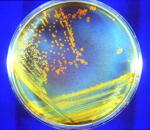 D rad Bacteria: Candidate Astronauts
22.01.2006
These bacteria could survive on another planet. In an Earth lab, Deinococcus radiodurans (D. rad) survive extreme levels of radiation, extreme temperatures, dehydration, and exposure to genotoxic chemicals. Amazingly, they even have the ability to repair their own DNA, usually with 48 hours. Known as an extremophile, bacteria such as D.
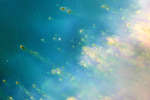 Curious Cometary Knots in the Helix Nebula
13.04.2008
What causes unusual knots of gas and dust in planetary nebulas? Seen also in the Ring Nebula, the Dumbbell Nebula and the Eskimo Nebula, the knots' existence was not initially predicted and their origins are still not well understood.
|
January February March April May June July August September October |
|||||||||||||||||||||||||||||||||||||||||||||||||