
|
You entered: telescope
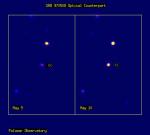 GRB970508 Delivers Predicted Radio Emission
21.05.1997
New evidence bolsters once controversial claims that Gamma-Ray Bursts (GRBs) are the most powerful explosions ever found by humanity. Two weeks ago, an average GRB became instantly historic when prompt, coincident X-ray and optical emissions were identified.
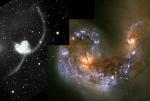 The Antennae Galaxies
22.10.1997
A ground-based telescopic view (left) of the collision between the galaxies NGC4038 and NGC4039 reveals long arcing insect-like "antennae" of luminous matter flung from the scene of the accident. Investigators using the Hubble Space...
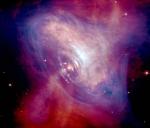 Composite Crab
4.09.2003
The Crab Pulsar, a city-sized, magnetized neutron star spinning 30 times a second, lies at the center of this composite image of the inner region of the well-known Crab Nebula. The spectacular picture combines...
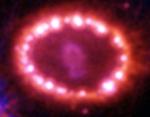 SN1987A s Cosmic Pearls
20.02.2004
In February 1987, light from the brightest stellar explosion seen in modern times reached Earth -- supernova SN1987A. This Hubble Space Telescope image from the sharp Advanced Camera for Surveys taken in November 2003 shows the explosion site over 16 years later.
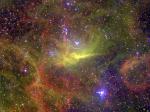 Nebulas Surrounding Wolf Rayet Binary
BAT99 49
Nebulas Surrounding Wolf Rayet Binary
BAT99 49
21.04.2004
How could two young stars power these colorful interstellar gas clouds? Although hidden by thick dust, the stars spew forceful ions and energetic radiation that cause the clouds to fragment and light up.
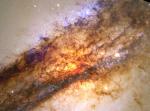 The Center of Centaurus A
17.07.2005
A fantastic jumble of young blue star clusters, gigantic glowing gas clouds, and imposing dark dust lanes surrounds the central region of the active galaxy Centaurus A. This mosaic of Hubble Space Telescope images taken in blue, green, and red light has been processed to present a natural color picture of this cosmic maelstrom.
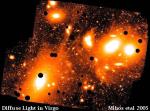 Streams of Stars in the Virgo Cluster of Galaxies
26.09.2005
How do huge clusters of galaxies evolve? To help find out, astronomers pointed the wide-angle Burrell-Schmidt telescope on Kitt Peak National Observatory in Arizona, USA at the nearby Virgo Cluster of Galaxies. After hundreds...
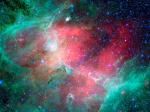 The Eagle Nebula in Infrared
11.01.2007
In visible light, the whole thing looks like an eagle. The region was captured recently in unprecedented detail in infrared light by the robotic orbiting Spitzer Space Telescope (SSC). Shown above, the infrared image...
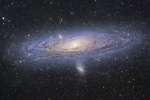 Andromeda Island Universe
24.01.2008
The most distant object easily visible to the unaided eye is M31, the great Andromeda Galaxy some two and a half million light-years away. But without a telescope, even this immense spiral galaxy - spanning over 200,000 light years - appears as a faint, nebulous cloud in the constellation Andromeda.
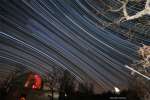 Haute Provence Star Trails
14.03.2009
Fix your camera to a tripod and you can record the graceful trails traced by the stars as planet Earth rotates on its axis. For example, this dramatic 5 hour long exposure was made on February 24 from Haute-Provence Observatory (OHP) in southeastern France.
|
January February March April May June July August September October |
|||||||||||||||||||||||||||||||||||||||||||||||||