
|
You entered: telescope
 A Quasar Portrait Gallery
25.11.1996
QUASARs (QUASi-stellAR objects) lie near the edge of the observable Universe. Discovered in 1963, astronomers were astounded - to be visible at such extreme distances of billions of light-years they must emit prodigious amounts of energy. Where does the energy come from?
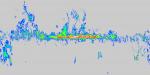 Milky Way Molecule Map
30.04.1997
Where are the Milky Way's gas clouds and where are they going? Stars form in gas clouds, and the motion of gas clouds tell us about the size and rotation speed of our own Milky Way Galaxy.
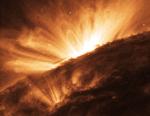 TRACE and the Active Sun
15.05.1998
This dramatic high resolution picture looking across the edge of the Sun was taken April 24th by a telescope on board the newly launched Transition Region and Coronal Explorer (TRACE) satellite. It shows graceful arcs of intensely hot gas suspended in powerful looping magnetic fields which soar above a solar active region.
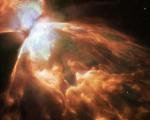 NGC 6302: Big Bright Bug Nebula
5.05.2004
The bright clusters and nebulae of planet Earth's night sky are often named for flowers or insects, and NGC 6302 is no exception. With an estimated surface temperature of about 250,000 degrees...
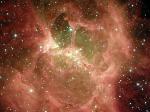 Spooky Star Forming Region DR 6
1.11.2004
How could stars form such a spooky and familiar shape as a human skull? First, the complex process of star formation creates nebulas of many shapes and sizes -- it is human perception that identifies the skull shape.
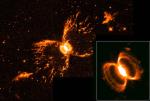 Symbiotic Star Bubbles
31.08.1999
The two stars at the center of this nebula are very different. One is a white dwarf star with a mass similar to our Sun but with a radius as small as our Earth.
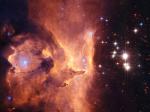 Massive Stars in Open Cluster Pismis 24
19.12.2006
How massive can a normal star be? Estimates made from distance, brightness and standard solar models had given one star in the open cluster Pismis 24 over 200 times the mass of our Sun, making it a record holder.
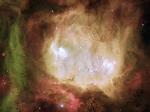 Halloween and the Ghost Head Nebula
31.10.2007
Halloween's origin is ancient and astronomical. Since the fifth century BC, Halloween has been celebrated as a cross-quarter day, a day halfway between an equinox (equal day / equal night) and a solstice (minimum day / maximum night in the northern hemisphere). With our modern calendar, however, the real cross-quarter day will occur next week.
 PanSTARRS: The Anti Tail Comet
29.06.2013
Once known as Earth's sunset comet, PanSTARRS (C/2011 L4) is up all night now, but only for northern hemisphere skygazers. Telescopes are required to track its progress as it fades and heads for the outer solar system.
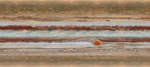 Jupiter in 2015
24.10.2015
Two remarkable global maps of Jupiter's banded cloud tops can be compared by just sliding your cursor over this sharp projection (or follow this link) of image data from the Hubble Space Telescope.
|
January February March April May June July August September October |
|||||||||||||||||||||||||||||||||||||||||||||||||