
|
You entered: telescope
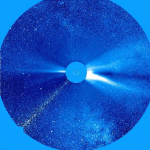 Solar Wind And Milky Way
4.03.1997
The Sun is bright, so bright that it overwhelms the light from other stars even for most satellite-borne telescopes. But LASCO, a coronograph onboard the space-based SOHO Observatory, uses occulting disks to block the intense solar light and examine the tenuous, hot gases millions of miles above the Sun's surface.
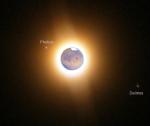 Mars Moons
24.10.2003
This year's record close approach of Mars inspired many to enjoy telescopic views of the red planet. But while Mars was so bright it was hard to miss, spotting Mars' two diminutive moons was still a good test for observers with modest sized instruments.
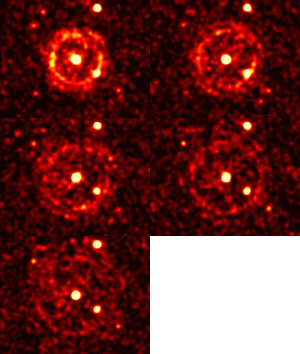 X Ray Rings Expand from a Gamma Ray Burst
30.01.2004
Why do x-ray rings appear to emanate from a gamma-ray burst? The surprising answer has little to do with the explosion itself but rather with light reflected off sheets of dust-laden gas in our own Milky Way Galaxy.
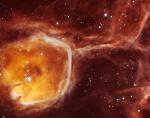 Windblown N44F
19.08.2004
A fast and powerful wind from a hot young star has created this stunning bubble-shaped nebula poised on the end of a bright filament of hydrogen gas. Cataloged as N44F, the cosmic windblown bubble is seen at the left of this Hubble Space Telescope image.
 Stars Forming in Serpens
31.08.2007
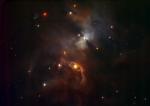
Stars are forming in a dense molecular cloud a mere 1,000 light-years away in the constellation Serpens Cauda (The Serpent's Tail). At that estimated distance, this sharp, near-infrared close-up of the active Serpens star-forming region spans about 2 arcminutes or just over half a light-year.
 Arp 272
30.04.2008
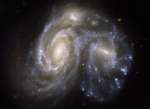
Linking spiral arms, two large colliding galaxies are featured in this Hubble Space Telescope view, part of a series of cosmic snapshots released to celebrate the Hubble's 18th anniversary. Recorded in astronomer Halton Arp's Atlas of Peculiar Galaxies as Arp 272, the pair is otherwise known as NGC 6050 and IC 1179.
 Comet Lulin Tails
7.02.2009
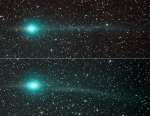
Sweeping through the inner solar system, Comet Lulin is easily visible in both northern and southern hemispheres with binoculars or a small telescope. Recent changes in Lulin's lovely greenish coma and tails are featured in this two panel comparison of images taken on January 31st (top) and February 4th.
 The Seagull Nebula
27.03.2009
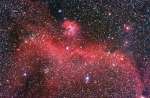
Images from two different cameras, a digital SLR and an astronomical ccd camera, are combined in this color starscape. Both cameras made use of the same telescope at the oceanside Winter Star Party in the Florida Keys, appropriately creating this portrait of the Seagull Nebula.
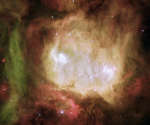 Halloween and the Ghost Head Nebula
31.10.2010
Halloween's origin is ancient and astronomical. Since the fifth century BC, Halloween has been celebrated as a cross-quarter day, a day halfway between an equinox (equal day / equal night) and a solstice (minimum day / maximum night in the northern hemisphere). With a modern calendar, however, the real cross-quarter day will occur next week.
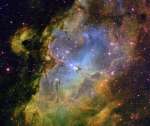 The Eagle Nebula from Kitt Peak
16.04.2012
From afar, the whole thing looks like an Eagle. A closer look at the Eagle Nebula, however, shows the bright region is actually a window into the center of a larger dark shell of dust. Through this window, a brightly-lit workshop appears where a whole open cluster of stars is being formed.
|
January February March April May June July August September October |
|||||||||||||||||||||||||||||||||||||||||||||||||