
|
You entered: telescope
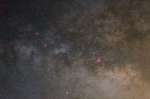 Messier s Eleven
12.07.2013
This fifteen degree wide field of view stretches across the crowded starfields of Sagittarius toward the center of our Milky Way galaxy. In fact, the center of the galaxy lies near the right edge of the rich starscape and eleven bright star clusters and nebulae fall near the center of the frame.
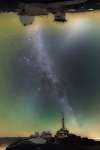 Crossing Horizons
25.11.2017
Follow this vertical panoramic view from horizon to horizon and your gaze will sweep through the zenith of a dark night sky over Pic du Midi mountaintop observatory. To make the journey above...
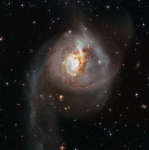 The Clash of NGC 3256
7.06.2018
Marked by an unusually bright central region, swirling dust lanes, and far flung tidal tails, peculiar NGC 3256 is the aftermath of a truly cosmic collision. The 500 million year old clash of two separate galaxies spans some 100 thousand light-years in this sharp Hubble view.
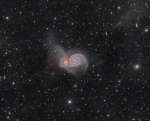 M51: The Whirlpool Galaxy
2.09.2022
Find the Big Dipper and follow the handle away from the dipper's bowl until you get to the last bright star. Then, just slide your telescope a little south and west and you'll come upon this stunning pair of interacting galaxies, the 51st entry in Charles Messier's famous catalog.
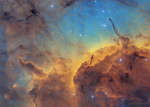 Stars, Dust, Pillars, and Jets in the Pelican Nebula
11.10.2022
What dark structures arise within the Pelican Nebula? On the whole, the nebula appears like a bird (a pelican) and is seen toward the constellation of a different bird: Cygnus, a Swan. But inside, the Pelican Nebula is a place lit up by new stars and befouled by dark dust.
 APOD: 2023 April 24 Б The Medulla Nebula Supernova Remnant
24.04.2023
What powers this unusual nebula? CTB-1 is the expanding gas shell that was left when a massive star toward the constellation of Cassiopeia exploded about 10,000 years ago. The star likely detonated when it ran out of elements near its core that could create stabilizing pressure with nuclear fusion.
 APOD: 2023 December 19 Б NGC 1499: The California Nebula
19.12.2023
Could Queen Calafia's mythical island exist in space? Perhaps not, but by chance the outline of this molecular space cloud echoes the outline of the state of California, USA. Our Sun has its home within the Milky Way's Orion Arm, only about 1,000 light-years from the California Nebula.
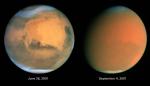 Mars Engulfed
17.10.2001
For months now, Mars has been engulfed by a great dust storm, the biggest seen raging across the Red Planet in decades. As a result, these two Hubble Space Telescope storm watch images from late June and early September offer dramatically contrasting views of the martian surface.
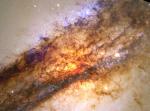 The Center of Centaurus A
21.04.2002
A fantastic jumble of young blue star clusters, gigantic glowing gas clouds, and imposing dark dust lanes surrounds the central region of the active galaxy Centaurus A. This mosaic of Hubble Space Telescope images taken in blue, green, and red light has been processed to present a natural color picture of this cosmic maelstrom.
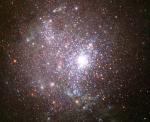 The Stars of NGC 1705
23.04.2003
Some 2,000 light-years across, NGC 1705 is small as galaxies go, similar to our Milky Way's own satellite galaxies, the Magellanic Clouds. At a much larger distance of 17 million light-years...
|
January February March April May June July August September October |
|||||||||||||||||||||||||||||||||||||||||||||||||