
|
You entered: telescope
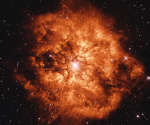 Wolf Rayet Star 124: Stellar Wind Machine
1.07.2014
Some stars explode in slow motion. Rare, massive Wolf-Rayet stars are so tumultuous and hot that they slowly disintegrating right before our telescopes. Glowing gas globs each typically over 30 times more massive than the Earth are being expelled by violent stellar winds.
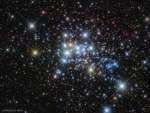 The Massive Stars in Westerlund 1
19.06.2017
Star cluster Westerlund 1 is home to some of the largest and most massive stars known. It is headlined by the star Westerlund 1-26, a red supergiant star so big that if placed in the center of our Solar System, it would extend out past the orbit of Jupiter.
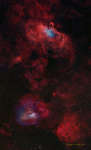 The Eagle and The Swan
23.08.2017
The Eagle Nebula and the Swan Nebula span this broad starscape, a telescopic view toward the Sagittarius spiral arm and the center of our Milky Way galaxy. The Eagle, also known as M16, is at top and M17, the Swan, at bottom of the frame showing the cosmic clouds as brighter regions of active star-formation.
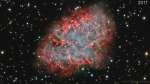 M1: The Incredible Expanding Crab Nebula
18.01.2020
Are your eyes good enough to see the Crab Nebula expand? The Crab Nebula is cataloged as M1, the first on Charles Messier's famous list of things which are not comets. In fact...
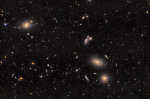 Virgo Cluster Galaxies
9.10.2020
Galaxies of the Virgo Cluster are scattered across this deep telescopic field of view. The cosmic scene spans about three Full Moons, captured in dark skies near Jalisco, Mexico, planet Earth. About 50 million light-years distant, the Virgo Cluster is the closest large galaxy cluster to our own local galaxy group.
 Peculiar Galaxies of Arp 273
8.01.2025
The colorful, spiky stars are in the foreground of this image taken with a small telescope on planet Earth. They lie well within our own Milky Way Galaxy. But the two eye-catching galaxies in the frame lie far beyond the Milky Way, at a distance of over 300 million light-years.
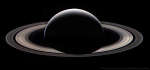 APOD: 2026 June 1 Б Saturn at Night
31.05.2026
Telescopic views of Saturn and its beautiful rings often make it the star of star parties. But this stunning view of the outer gas gaint planet's rings and night side just isn't possible from telescopes in the vicinity of planet Earth.
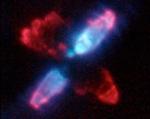 Shells in the Egg Nebula
26.06.1999
The Egg Nebula is taking a beating. Like a baby chick pecking its way out of an egg, the star in the center of the Egg Nebula is casting away shells of gas and dust as it slowly transforms itself into a white dwarf star.
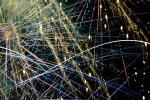 Fireworks and Shooting Stars
9.08.2002
Experimenting with a new telescope and camera, photographer Jim Steele captured this surreal but festive image of fireworks in the night sky above Ashland, Oregon. The date was July 4th and the fiery streaks were part of the traditional annual celebration of independence day in the United States.
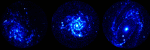 A Spiral Galaxy Gallery
9.04.1996
A progression of beautiful spiral galaxies is illustrated above with three photographs from NASA's Ultraviolet Imaging Telescope (UIT). Flying above the Earth's obscuring layer of atmosphere on the Space Shuttle Columbia during...
|
January February March April May June July August September October |
|||||||||||||||||||||||||||||||||||||||||||||||||