
|
You entered: Moon
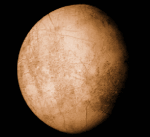 Europa: Oceans of Life?
6.08.1996
Is there life beneath Europa's frozen surface? Some believe the oceans found there of carbon-enriched water are the best chance for life, outside the Earth, in our Solar System. Europa, the fourth largest moon of Jupiter, was recently discovered to have a thin oxygen atmosphere by scientists using the Hubble Space Telescope.
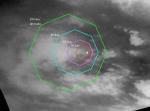 Descent to Titan
14.01.2005
Today's descent to the surface of Titan by the European Space Agency's Huygens probe is the most distant landing ever attempted by a spacecraft from Earth. At 10:13 UT (5:13am...
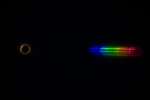 The Flash Spectrum of the Sun
15.11.2013
In a flash, the visible spectrum of the Sun changed from absorption to emission on November 3rd, during the brief total phase of a solar eclipse. That fleeting moment is captured by telephoto lens and diffraction grating in this well-timed image from clearing skies over Gabon in equatorial Africa.
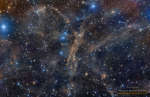 A Dust Angel Nebula
28.04.2016
The combined light of stars along the Milky Way are reflected by these cosmic dust clouds that soar some 300 light-years or so above the plane of our galaxy. Dubbed the Angel Nebula, the faint apparition is part of an expansive complex of dim and relatively unexplored, diffuse molecular clouds.
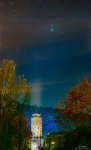 December s Comet Wirtanen
7.12.2018
Coming close in mid-December, Comet 46P Wirtanen hangs in this starry sky over the bell tower of a Romanesque church. In the constructed vertical panorama, a series of digital exposures capture its greenish coma on December 3 from Sant Llorenc de la Muga, Girona, Catalonia, Spain, planet Earth.
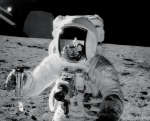 Apollo 12: Self Portrait
24.11.2019
Is this image art? 50 years ago, Apollo 12 astronaut-photographer Charles "Pete" Conrad recorded this masterpiece while documenting colleague Alan Bean's lunar soil collection activities on Oceanus Procellarum. The featured image is dramatic and stark.
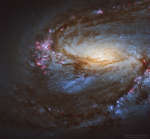 Spiral Galaxy M66 from Hubble
24.02.2021
ItБs always nice to get a new view of an old friend. This stunning Hubble Space Telescope image of nearby spiral galaxy M66 is just that. A spiral galaxy with a small central bar, M66 is a member of the Leo Galaxy Triplet, a group of three galaxies about 30 million light years from us.
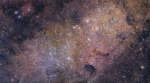 APOD: 2026 July 11 Б Messier 24: Sagittarius Star Cloud
11.07.2026
Unlike most entries in Charles Messier's famous catalog of deep sky objects, M24 is not a bright galaxy, star cluster, or nebula. It's a gap in nearby, obscuring interstellar dust clouds that allows a view of the distant stars in the Sagittarius spiral arm of our Milky Way galaxy.
 A Window to the Once Secret Sky
13.04.2005
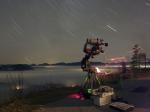
If there was a window nearby to the distant universe -- would you look through it? Quite possibly, there is, in the form of a small telescope. A local skykeeper could be a relative or a stranger and is frequently proud to show off the sky free of charge.
 USNO A2.0 Catalog: A Digital Sky
26.04.1999
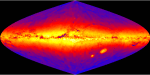
Here lie 526,230,881 of the brightest stars known. The US Naval Observatory has deployed their monster Precision Measuring Machine to digitize photographic plates covering the whole sky and creating the above map. Yellow corresponds to 150,000 stars per square degree, while dark blue corresponds to only 500 stars per square degree.
|
January February March April May June July August September October |
|||||||||||||||||||||||||||||||||||||||||||||||||