
|
You entered: Moon
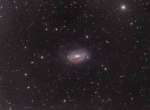 M63: Sunflower Galaxy Wide Field
3.08.2016
The Sunflower Galaxy blooms near the center of this wide field telescopic view. The scene spans about 2 degrees or 4 full moons on the sky toward the loyal constellation Canes Venatici. More formally...
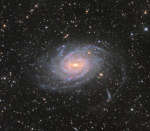 Spiral Galaxy NGC 6744
4.12.2019
Beautiful spiral galaxy NGC 6744 is nearly 175,000 light-years across, larger than our own Milky Way. It lies some 30 million light-years distant in the southern constellation Pavo and appears as only a faint, extended object in small telescopes.
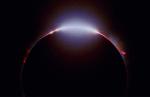 Madagascar Totality
26.07.2001
When the Moon's shadow reached out and touched Earth's southern hemisphere on 2001 June 21, the first total solar eclipse of the 21st century began. Starting in the Atlantic, the dark, central...
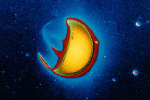 Ultraviolet Earth
10.06.1996
Here's a switch: the above picture is of the Earth taken from a lunar observatory! This false color picture shows how the Earth glows in ultraviolet (UV) light. UV light is so blue humans can't see it.
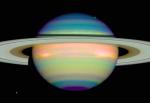 Infrared Saturn
21.02.2003
This delightfully detailed false-color image of Saturn was taken in January 1998 by the orbiting Hubble Space Telescope. The picture is a combination of three images from Hubble's NICMOS instrument and shows the lovely ringed planet in reflected infrared sunlight.
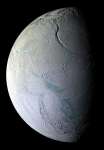 Labtayt Sulci on Saturns Enceladus
21.12.2008
Do some surface features on Enceladus roll like a conveyor belt? A leading interpretation of recent images taken of Saturn's most explosive moon indicate that they do. This form of asymmetric tectonic activity...
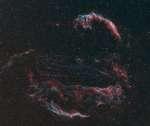 The Veil Nebula
16.09.2010
Delicate in appearance, these filaments of shocked, glowing gas, draped in planet Earth's sky toward the constellation of Cygnus, make up the Veil Nebula. The nebula is a large supernova remnant, an expanding cloud born of the death explosion of a massive star.
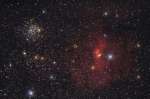 The Bubble and M52
14.09.2011
To the eye, this cosmic composition nicely balances the Bubble Nebula at the lower right with open star cluster M52. The pair would be lopsided on other scales, though. Embedded in a complex...
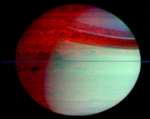 Lantern Saturn
31.05.2012
Known for its bright ring system and many moons, gas giant Saturn looks strange and unfamiliar in this false-color view from the Cassini spacecraft. In fact, in this Visual and Infrared Mapping Spectrometer (VIMS) mosaic the famous rings are almost invisible, seen edge-on cutting across picture center.
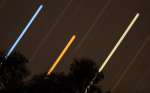 Conjunction Colours
23.08.2012
During the past week, nightfall on planet Earth has featured Mars, Saturn, and Spica in a lovely conjunction near the western horizon. Still forming the corners of a distinctive celestial triangle after sunset...
|
January February March April May June July August September October |
|||||||||||||||||||||||||||||||||||||||||||||||||