
|
You entered: Moon
 Spiral Galaxy NGC 6744
1.11.2024
Big, beautiful spiral galaxy NGC 6744 is nearly 175,000 light-years across, larger than our own Milky Way. It lies some 30 million light-years distant in the southern constellation Pavo but appears as only a faint smudge in the eyepiece of a small telescope.
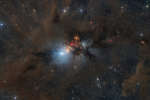 NGC 1333: Stellar Nursery in Perseus
30.01.2026
NGC 1333 is seen in visible light as a reflection nebula, dominated by bluish hues characteristic of starlight reflected by interstellar dust. A mere 1,000 light-years distant toward the heroic constellation Perseus, it lies at the edge of a large, star-forming molecular cloud.
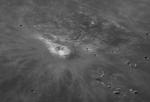 Aristarchus Plateau
30.11.2007
Anchored in the vast lava flows of the Moon's Oceanus Procellarum lies the Aristarchus Plateau. The bright impact crater at the corner of the plateau is Aristarchus, a young crater 42 kilometers wide and 3 kilometers deep. Only slightly smaller, lava flooded Herodotus crater is above and to the left.
 Easter Island Eclipse
14.07.2010
Makemake, a god in Easter Island mythology, may have smiled for a moment as clouds parted long enough to reveal this glimpse of July 11's total solar eclipse to skygazers. In the foreground...
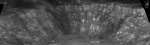 At the West Wall of Aristarchus Crater
17.02.2012
Aristarchus Plateau is anchored in the vast lava flows of the Moon's Oceanus Procellarum. At the plateau's southeastern edge lies the spectacular Aristarchus Crater, an impact crater 40 kilometers wide and 3 kilometers deep.
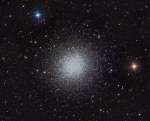 M13: The Great Globular Cluster in Hercules
14.06.2012
In 1716, English astronomer Edmond Halley noted, "This is but a little Patch, but it shews itself to the naked Eye, when the Sky is serene and the Moon absent." Of course, M13 is now modestly recognized as the Great Globular Cluster in Hercules, one of the brightest globular star clusters in the northern sky.
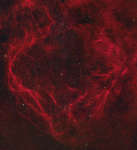 RCW 114: A Dragon s Heart in Ara
11.01.2018
Large and dramatically shaped, this cosmic cloud spans nearly 7 degrees or 14 full moons across planet Earth's sky toward the southern constellation Ara. Difficult to image, the filamentary apparition is cataloged as RCW 114 and traced in this telescopic mosaic by the telltale reddish emission of ionized hydrogen atoms.
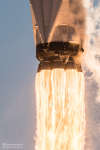 TESS Launch Close Up
21.04.2018
NASA's Transiting Exoplanet Survey Satellite (TESS) began its search for planets orbiting other stars by leaving planet Earth on April 18. The exoplanet hunter rode to orbit on top of a Falcon 9 rocket.
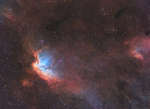 The Wizard Nebula
4.09.2020
Open star cluster NGC 7380 is still embedded in its natal cloud of interstellar gas and dust popularly known as the Wizard Nebula. Seen on the left, with foreground and background stars along the plane of our Milky Way galaxy it lies some 8,000 light-years distant, toward the constellation Cepheus.
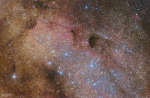 Messier 24: Sagittarius Star Cloud
7.04.2022
Unlike most entries in Charles Messier's famous catalog of deep sky objects, M24 is not a bright galaxy, star cluster, or nebula. It's a gap in nearby, obscuring interstellar dust clouds that allows a view of the distant stars in the Sagittarius spiral arm of our Milky Way galaxy.
|
January February March April May June July August September October |
|||||||||||||||||||||||||||||||||||||||||||||||||