
|
You entered: Moon
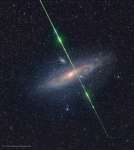 Meteor before Galaxy
7.08.2022
What's that green streak in front of the Andromeda galaxy? A meteor. While photographing the Andromeda galaxy in 2016, near the peak of the Perseid Meteor Shower, a small pebble from deep space crossed right in front of our Milky Way Galaxy's far-distant companion.
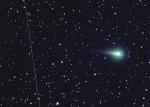 Announcing Comet C 2002 T7 LINEAR
9.02.2004
A newly discovered comet may outshine most stars in the sky by May. Designated Comet C/2002 T7 (LINEAR), the comet was discovered in 2002 October by project LINEAR. Many reports already place the comet as brighter than magnitude 7, meaning that it can now be seen with binoculars.
 Thin Rings Around Polarized Saturn
19.12.2005
How thin are the rings of Saturn? Brightness measurements from different angles have shown Saturn's rings to be about one kilometer thick, making them many times thinner, in relative proportion, than a razor blade. This thinness sometimes appears in dramatic fashion during an image taken nearly along the ring plane.
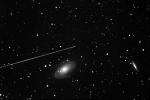 Asteroid and Galaxy
5.04.2007
Apollo class asteroid 2006 VV2 flashed past planet Earth in late March, approaching to within 3.4 million kilometers or about 8.8 times the Earth-Moon distance. Due to the proximity of its orbit to Earth and its estimated diameter of over 1 kilometer, 2006 VV2 is classified as a Potentially Hazardous Asteroid.
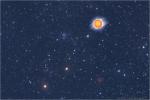 Stars and the Solstice Sun
21.06.2007
If you could turn off the atmosphere's ability to scatter overwhelming sunlight, today's daytime sky might look something like this ... with the Sun surrounded by the stars of the constellations Taurus and Gemini. Of course, today is the Solstice.
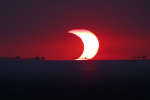 A Partial Eclipse Over Manila Bay
28.01.2009
What's happened to the setting Sun? An eclipse! Two days ago, the Moon eclipsed part of the Sun as visible from parts of Africa, Australia, and Asia. In particular the above image, taken from the Mall of Asia seawall, caught a partially eclipsed Sun setting over Manila Bay in the Philippines.
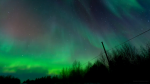 Time Lapse Auroras Over Norway
28.03.2011
Sometimes, after your eyes adapt to the dark, a spectacular sky appears. Such was the case earlier this month when one of the largest auroral displays in recent years appeared over northern locations like the border between Norway and Russia.
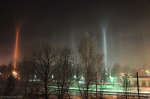 Unusual Light Pillars over Latvia
27.12.2014
What's happening over that town? Close inspection shows these strange columns of light occur over bright lights, and so likely are light pillars that involve falling ice crystals reflecting back these lights. The above image and several similar images were taken with a standard digital camera in Sigulda, Latvia in late 2009.
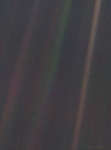 The Largest Rock in our Solar System
1.01.2023
There, that dot on the right, that's the largest rock known in our Solar System. It is larger than every known asteroid, moon, and comet nucleus. It is larger than any other local rocky planet.
 Crescents of Venus
26.08.2023
Just as the Moon goes through phases, Venus' visible sunlit hemisphere waxes and wanes. This sequence of telescopic images illustrates the steady changes for Venus during its recent 2023 apparition as our evening star. Gliding along its interior orbit between Earth and Sun, Venus grows larger during that period because it is approaching planet Earth.
|
January February March April May June July August September October |
|||||||||||||||||||||||||||||||||||||||||||||||||