
|
You entered: light
 APOD: 2024 September 8 Б M31: The Andromeda Galaxy
8.09.2024
The most distant object easily visible to the unaided eye is M31, the great Andromeda Galaxy. Even at some two and a half million light-years distant, this immense spiral galaxy -- spanning over 200,000 light years -- is visible, although as a faint, nebulous cloud in the constellation Andromeda.
 Young Star Cluster NGC 1333
12.09.2024
This spectacular mosaic of images from the James Webb Space Telescope peers into the heart of young star cluster NGC 1333. A mere 1,000 light-years distant toward the heroic constellation Perseus, the nearby star cluster lies at the edge of the large Perseus molecular cloud.
 APOD: 2024 December 3 Б Ice Clouds over a Red Planet
3.12.2024
If you could stand on Mars -- what might you see? You might look out over a vast orange landscape covered with rocks under a dusty orange sky, with a blue-tinted Sun setting over the horizon, and odd-shaped water clouds hovering high overhead.
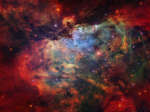 APOD: 2026 June 10 Б The Eagle Nebula and Friends
10.06.2026
What looks as if it is going to swallow the great Pillars of Creation? The Eagle Nebula (M16) is not a bird, a plane, or Superman. M16 is actually a combination of several celestial objects. NGC 6611 is the young star cluster that appears to peak out beneath the EagleБs БwingsБ.
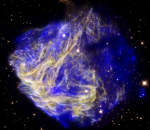 Fast Gas Bullet from Cosmic Blast N49
30.06.2010
What is that strange blue blob on the far right? No one is sure, but it might be a speeding remnant of a powerful supernova that was unexpectedly lopsided. Scattered debris from supernova explosion N49 lights up the sky in this gorgeous composited image based on data from the Chandra and Hubble Space Telescopes.
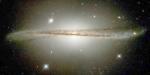 Warped Spiral Galaxy ESO 510 13
3.08.2001
How did spiral galaxy ESO 510-13 get bent out of shape? The disks of many spirals are thin and flat, but not solid. Spiral disks are loose conglomerations of billions of stars and diffuse gas all gravitationally orbiting a galaxy center.
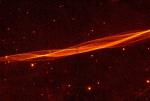 Filaments in the Cygnus Loop
18.01.2003
Subtle and delicate in appearance, these are filaments of shocked interstellar gas -- part of the expanding blast wave from a violent stellar explosion. Recorded in November 1997 with the Wide Field and Planetary Camera 2 on board the Hubble Space Telescope, the picture is a closeup of a supernova remnant known as the Cygnus Loop.
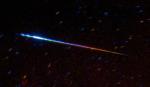 A Perseid Meteor
11.08.1997
Tonight the Perseid Meteor Shower reaches its maximum. Grains of rocky ice will streak across the sky as they evaporate during entry into Earth's atmosphere. These ice chips were shed from Comet Swift-Tuttle. The Perseids result from the annual crossing of the Earth through Comet Swift-Tuttle's orbit.
 Beta Pictoris Revisited
28.11.1997
In the early 1980s, Beta Pictoris became one of the most important stars in the sky. Satellite and ground-based telescopic observations revealed the presence of a surrounding outer disk of material and an inner "clear" zone about the size of our solar system - strong evidence for the formation of planets.
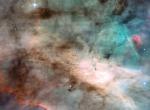 In the Center of the Omega Nebula
8.02.2004
In the depths of the dark clouds of dust and molecular gas known as the Omega Nebula, stars continue to form. The above image from the Hubble Space Telescope's Advanced Camera for Surveys shows exquisite detail in the famous star-forming region.
|
January February March April May June July August September October |
|||||||||||||||||||||||||||||||||||||||||||||||||