
|
You entered: light
 NGC 2419 Intergalactic Wanderer
4.06.2015
Three objects stand out in this thoughtful telescopic image, a view toward the mostly stealthy constellation Lynx. The two brightest (the spiky ones) are nearby stars. The third is the remote globular star cluster NGC 2419, at distance of nearly 300,000 light-years.
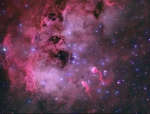 The Tadpoles of IC 410
13.11.2015
This telescopic close-up shows off the otherwise faint emission nebula IC 410. It also features two remarkable inhabitants of the cosmic pond of gas and dust below and right of center, the tadpoles of IC 410. Partly obscured by foreground dust, the nebula itself surrounds NGC 1893, a young galactic cluster of stars.
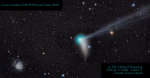 The View Toward M101
21.01.2016
Sweeping through northern skies, Comet Catalina (C/2013 US10) made its closest approach on January 17, passing about 6 light-minutes from our fair planet. Dust and ion tails clearly separated in this Earth-based view, the comet is also posed for a Messier moment, near the line-of-sight to M101, grand spiral galaxy in Ursa Major.
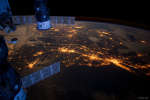 USAs Northeast Megalopolis from Space
24.02.2016
Can you identify a familiar area in the northeast USA just from nighttime lights? It might be possible because many major cities are visible, including (right to left) New York, Philadelphia, Baltimore, Washington, Richmond and Norfolk -- Boston of the USA's Northeast megalopolis is not pictured.
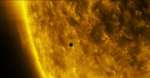 A Mercury Transit Music Video from SDO
11.05.2016
What's that small black dot moving across the Sun? Mercury. Possibly the clearest view of Mercury crossing in front of the Sun earlier this week was from Earth orbit. The Solar Dynamics Observatory obtained an uninterrupted vista recording it not only in optical light but also in bands of ultraviolet light.
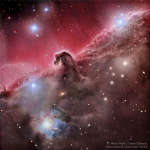 The Magnificent Horsehead Nebula
25.12.2016
Sculpted by stellar winds and radiation, a magnificent interstellar dust cloud by chance has assumed this recognizable shape. Fittingly named the Horsehead Nebula, it is some 1,500 light-years distant, embedded in the vast Orion cloud complex.
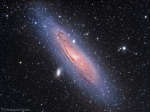 M31: The Andromeda Galaxy
27.12.2016
What is the nearest major galaxy to our own Milky Way Galaxy? Andromeda. In fact, our Galaxy is thought to look much like Andromeda. Together these two galaxies dominate the Local Group of galaxies. The diffuse light from Andromeda is caused by the hundreds of billions of stars that compose it.
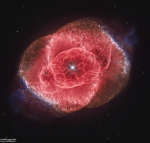 The Cats Eye Nebula from Hubble
30.01.2017
To some, it may look like a cat's eye. The alluring Cat's Eye nebula, however, lies three thousand light-years from Earth across interstellar space. A classic planetary nebula, the Cat's Eye (NGC 6543) represents a final, brief yet glorious phase in the life of a sun-like star.
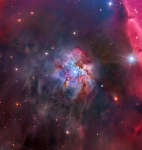 NGC 2023 in the Horsehead s Shadow
29.03.2018
Carved by a bright young star in Orion's dusty molecular clouds, NGC 2023 is often overlooked in favor of the nearby dramatic silhouette of the Horsehead Nebula. In its own right it is seen as a beautiful star forming emission and reflection nebula though, a mere 1500 light-years distant.
 Window Seat over Hudson Bay
22.09.2018
On the August 18 night flight from San Francisco to Zurich, a window seat offered this tantalizing view when curtains of light draped a colorful glow across the sky over Hudson Bay. Constructed...
|
January February March April May June July August September October |
|||||||||||||||||||||||||||||||||||||||||||||||||