
|
You entered: light
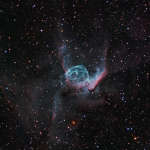 Thor s Helmet
7.03.2013
This helmet-shaped cosmic cloud with wing-like appendages is popularly called Thor's Helmet. Heroically sized even for a Norse god, Thor's Helmet is about 30 light-years across. In fact, the helmet is actually...
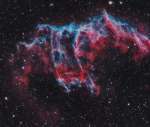 A Spectre in the Eastern Veil
30.10.2013
Frightening forms and scary faces are a mark of the Halloween season. They also haunt this cosmic close-up of the eastern Veil Nebula. The Veil Nebula itself is a large supernova remnant, the expanding debris cloud from the death explosion of a massive star.
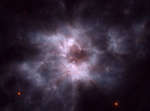 NGC 2440: Pearl of a New White Dwarf
17.05.2015
Like a pearl, a white dwarf star shines best after being freed from its shell. In this analogy, however, the Sun would be a mollusk and its discarded hull would shine prettiest of all!
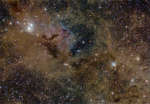 Stardust in Perseus
10.10.2015
This cosmic expanse of dust, gas, and stars covers some 6 degrees on the sky in the heroic constellation Perseus. At upper left in the gorgeous skyscape is the intriguing young star cluster IC 348 and neighboring Flying Ghost Nebula.
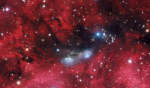 The NGC 6914 Complex
30.08.2018
A study in contrasts, this colorful skyscape features stars, dust, and glowing gas in the vicinity of NGC 6914. The complex of reflection nebulae lies some 6,000 light-years away, toward the high-flying northern constellation Cygnus and the plane of our Milky Way Galaxy.
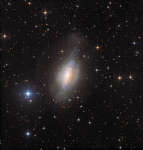 NGC 3521: Galaxy in a Bubble
2.04.2021
Gorgeous spiral galaxy NGC 3521 is a mere 35 million light-years away, toward the constellation Leo. Relatively bright in planet Earth's sky, NGC 3521 is easily visible in small telescopes but often overlooked by amateur imagers in favor of other Leo spiral galaxies, like M66 and M65.
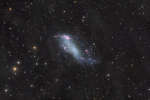 IC 2574: Coddington s Nebula
19.02.2026
Grand spiral galaxies often seem to get all the glory, flaunting their young, bright, blue star clusters in beautiful, symmetric spiral arms. But small, irregular galaxies form stars too. In fact, dwarf galaxy IC 2574 shows clear evidence of intense star forming activity in its telltale reddish regions of glowing hydrogen gas.
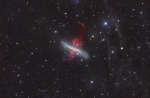 APOD: 2026 April 17 Б M82: Starburst Galaxy with a Superwind
17.04.2026
Messier 82 is a starburst galaxy with a superwind. In fact, through supernova explosions and powerful winds from massive stars, the burst of star formation in M82 is driving a prodigious outflow. Evidence for the superwind from the galaxy's central regions is clear in the sharp telescopic portrait.
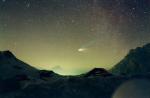 Comet Hale Bopp Over Val Parola Pass
28.06.1998
In 1997, Comet Hale-Bopp became much brighter than any surrounding stars. It could be seen even over bright city lights. Out away from city lights, however, it put on quite a spectacular show. Here Comet Hale-Bopp was photographed last March above Val Parola Pass in the Dolomite mountains surrounding Cortina d'Ampezzo, Italy.
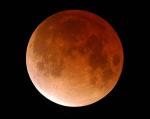 Sunset Moonlight
21.11.2003
November's lunar eclipse was one of the shortest in recent years and also one of the brightest -- demonstrating that the Earth's shadow is not completely dark. The eclipsed Moon remained easily visible...
|
January February March April May June July August September October |
|||||||||||||||||||||||||||||||||||||||||||||||||