
|
You entered: light
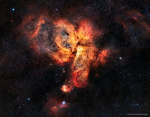 The Great Nebula in Carina
13.06.2017
In one of the brightest parts of Milky Way lies a nebula where some of the oddest things occur. NGC 3372, known as the Great Nebula in Carina, is home to massive stars and changing nebulas.
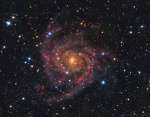 IC 342: The Hidden Galaxy
16.01.2019
Similar in size to large, bright spiral galaxies in our neighborhood, IC 342 is a mere 10 million light-years distant in the long-necked, northern constellation Camelopardalis. A sprawling island universe, IC 342 would otherwise...
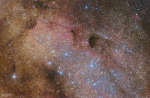 Messier 24: Sagittarius Star Cloud
7.04.2022
Unlike most entries in Charles Messier's famous catalog of deep sky objects, M24 is not a bright galaxy, star cluster, or nebula. It's a gap in nearby, obscuring interstellar dust clouds that allows a view of the distant stars in the Sagittarius spiral arm of our Milky Way galaxy.
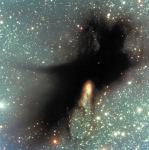 BHR 71: Stars, Clouds, and Jets
27.01.2003
What is happening to molecular cloud BHR 71? Quite possible, a binary star system is forming inside. Most stars in our Galaxy are part of binary star systems, but few have ever been seen in formation.
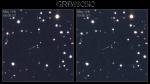 GRB 990510: Another Unusual Gamma Ray Burst
26.05.1999
Another huge explosion has lit up the universe, and astronomers are studying it as best they can before the light fades away. Two weeks ago, the BATSE instrument on the orbiting NASA Great Observatory Compton detected unusually bright flashes of gamma-rays from a point deep in the southern sky.
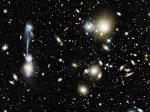 A Galactic Collision in Cluster Abell 1185
22.11.2005
What is a guitar doing in a cluster of galaxies? Colliding. Clusters of galaxies are sometimes packed so tight that the galaxies that compose them collide. A prominent example occurs on the left of the above image of the rich cluster of galaxies Abell 1185.
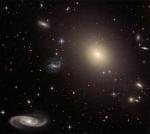 Galaxies Away
8.02.2007
This stunning group of galaxies is far, far away - about 450 million light-years from planet Earth - cataloged as galaxy cluster Abell S0740. Dominated by the cluster's large central elliptical galaxy (ESO 325-G004), this...
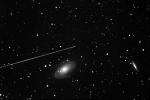 Asteroid and Galaxy
5.04.2007
Apollo class asteroid 2006 VV2 flashed past planet Earth in late March, approaching to within 3.4 million kilometers or about 8.8 times the Earth-Moon distance. Due to the proximity of its orbit to Earth and its estimated diameter of over 1 kilometer, 2006 VV2 is classified as a Potentially Hazardous Asteroid.
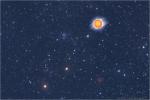 Stars and the Solstice Sun
21.06.2007
If you could turn off the atmosphere's ability to scatter overwhelming sunlight, today's daytime sky might look something like this ... with the Sun surrounded by the stars of the constellations Taurus and Gemini. Of course, today is the Solstice.
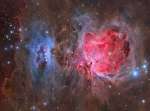 Great Orion Nebulae
23.10.2008
The Great Nebula in Orion, also known as M42, is one of the most famous nebulae in the sky. The star forming region's glowing gas clouds and hot young stars...
|
January February March April May June July August September October |
|||||||||||||||||||||||||||||||||||||||||||||||||