
|
You entered: light
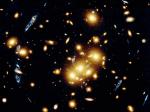 Giant Cluster Bends, Breaks Images
23.04.2000
What are those strange blue objects? Many are images of a single, unusual, beaded, blue, ring-like galaxy which just happens to line-up behind a giant cluster of galaxies. Cluster galaxies here appear yellow and -- together with the cluster's dark matter -- act as a gravitational lens.
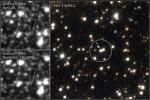 A Big Black Hole Floats By
19.01.2000
A black hole glides silently through space. Is there any way to know it's there? Until last week, all objects that might be black holes in our Galaxy were part of binary star systems.
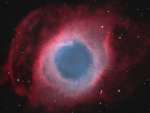 Spokes in the Helix Nebula
4.09.2008
At first glance, the Helix Nebula (aka NGC 7293), looks simple and round. But this well-studied example of a planetary nebula, produced near the end of the life of a sun-like star, is now understood to have a surprisingly complex geometry. Its extended loops and comet-shaped features have been explored in Hubble Space Telescope images.
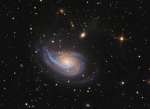 Arp 78: Peculiar Galaxy in Aries
7.07.2011
Peculiar spiral galaxy Arp 78 is found within the boundaries of the head strong constellation Aries, some 100 million light-years beyond the stars and nebulae of our Milky Way galaxy. Also known...
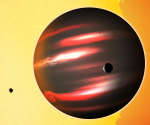 TrES 2b: Dark Planet
22.08.2011
Why is this planet so dark? Planet TrES-2b reflects back less than one percent of the light it receives, making it darker than any known planet or moon, darker even than coal. Jupiter-sized TrES-2b...
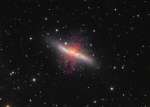 M82: Starburst Galaxy with a Superwind
6.10.2011
Also known as the Cigar Galaxy for its elongated visual appearance, M82 is a starburst galaxy with a superwind. In fact, through ensuing supernova explosions and powerful winds from massive stars, the burst of star formation in M82 is driving the prodigous outflow of material.
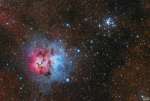 Messier 20 and 21
28.08.2014
The beautiful Trifid Nebula, also known as Messier 20, is easy to find with a small telescope in the nebula rich constellation Sagittarius. About 5,000 light-years away, the colorful study in cosmic contrasts shares this well-composed, nearly 1 degree wide field with open star cluster Messier 21 (top right).
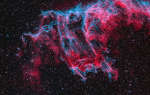 A Spectre in the Eastern Veil
29.10.2014
Frightening forms and scary faces are a mark of the Halloween season. They also haunt this cosmic close-up of the eastern Veil Nebula. The Veil Nebula itself is a large supernova remnant, the expanding debris cloud from the death explosion of a massive star.
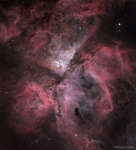 The Great Nebula in Carina
23.03.2016
In one of the brightest parts of Milky Way lies a nebula where some of the oddest things occur. NGC 3372, known as the Great Nebula in Carina, is home to massive stars and changing nebulas.
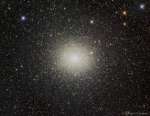 Omega Centauri: The Brightest Globular Star Cluster
27.04.2016
This huge ball of stars predates our Sun. Long before humankind evolved, before dinosaurs roamed, and even before our Earth existed, ancient globs of stars condensed and orbited a young Milky Way Galaxy. Of the 200 or so globular clusters that survive today, Omega Centauri is the largest, containing over ten million stars.
|
January February March April May June July August September October |
|||||||||||||||||||||||||||||||||||||||||||||||||