
|
You entered: light
 LEDA 1313424: The Bullseye Galaxy
7.02.2025
The giant galaxy cataloged as LEDA 1313424 is about two and a half times the size of our own Milky Way. Its remarkable appearance in this recently released Hubble Space Telescope image strongly suggests its nickname "The Bullseye Galaxy".
 APOD: 2025 September 19 Б The NGC 6914 Complex
19.09.2025
A study in contrasts, this colorful cosmic skyscape features stars, dust, and glowing gas in the vicinity of NGC 6914. The interstellar complex of nebulae lies some 6,000 light-years away, toward the high-flying northern constellation Cygnus and the plane of our Milky Way Galaxy.
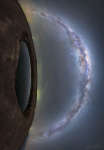 APOD: 2026 April 19 Б Eye on the Milky Way
19.04.2026
Have you ever had stars in your eyes? It appears that the eye on the left does, and moreover, it appears to be gazing at even more stars. The featured 27-frame mosaic was taken in 2019 from Ojas de Salar in the Atacama Desert of Chile.
 The Bubble
16.07.2004
Blown by the wind from a star, this tantalizing, ghostly apparition is cataloged as NGC 7635, but known simply as The Bubble Nebula. Astronomer Ken Crawford's striking view combines a long exposure through a hydrogen alpha filter with color images to reveal the intricate details of this cosmic bubble and its environment.
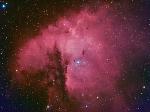 NGC 281: Cluster, Clouds, and Globules
20.10.2004
NGC 281 is a busy workshop of star formation. Prominent features include a small open cluster of stars, a diffuse red-glowing emission nebula, large lanes of obscuring gas and dust, and dense knots of dust and gas in which stars may still be forming.
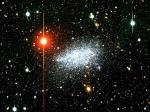 Leo A: Nearby Dwarf Irregular Galaxy
10.11.2004
Why isn't this small galaxy simple? The above image and contemporary observations of small nearby galaxy Leo A were supposed to show it has a simple structure. Now Leo A is known...
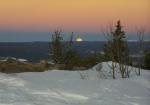 Shadow Set
27.01.2005
A nearly full Moon and planet Earth's shadow set together in this scene captured Monday from snowy Mt. Jelm, home of the Wyoming Infrared Observatory. For early morning risers (and late...
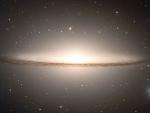 The Sombrero Galaxy from VLT
28.02.2000
Why does the Sombrero Galaxy look like a hat? Reasons include the Sombrero's unusually large and extended central bulge of stars, and dark prominent dust lanes that appear in a disk that we see nearly edge-on. Billions of old stars cause the diffuse glow of the extended central bulge.
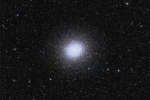 Omega Centauri: The Largest Globular Cluster Known
1.03.2009
This huge ball of stars predates our Sun. Long before humankind evolved, before dinosaurs roamed, and even before our Earth existed, ancient globs of stars condensed and orbited a young Milky Way Galaxy. Of the 200 or so globular clusters that survive today, Omega Centauri is the largest, containing over ten million stars.
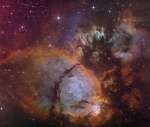 The Colors of IC 1795
10.12.2009
This colorful cosmic portrait features glowing gas and dark dust clouds in IC 1795, a star forming region in the northern constellation Cassiopeia. The nebula's colors were created by adopting the Hubble false-color...
|
January February March April May June July August September October |
|||||||||||||||||||||||||||||||||||||||||||||||||