
|
You entered: light
 Orion Nebula in Oxygen, Hydrogen, and Sulfur
13.07.2004
The Great Nebula in Orion, an immense, nearby starbirth region, is arguably the most famous of all astronomical nebulae. The Orion Nebula, also known as M42, is shown above through ultraviolet and blue filters augmented with three exact colors specifically emitted by hydrogen, oxygen, and sulfur.
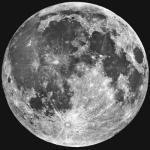 The Full Moon
19.04.1999
Earth has one moon. A symbol in famous love songs, movies, poems, and folklore, many myths about the Moon date back to ancient history. In fact, the name Monday originates from Moon-day. The Moon glows by light it reflects from the Sun and is frequently the brightest object in the night sky.
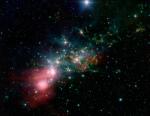 Dusty NGC 1333
24.11.2005
Dusty NGC 1333 is seen as a reflection nebula in visible light images, sporting bluish hues characteristic of starlight reflected by dust. But at longer infrared wavelengths, the interstellar dust itself glows - shown in red in this false-color Spitzer Space Telescope image.
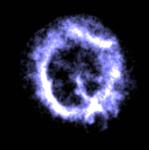 X-ray Hot Supernova Remnant in the SMC
9.12.1999
The Q-shaped cloud seen in this false-color X-ray image from the orbiting Chandra Observatory is big ... about 40 light-years across. It's hot too, as its X-ray glow is produced by multi-million degree gas.
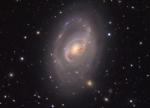 Messier 96
15.06.2007
Dust lanes seem to swirl around the core of Messier 96 in this colorful, detailed portrait of the beautiful island universe. Of course M96 is a spiral galaxy, and counting the faint arms extending beyond the brighter central region it spans 100 thousand light-years or so, about the size of our own Milky Way.
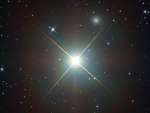 Mirach s Ghost
29.10.2008
As far as ghosts go, Mirach's Ghost isn't really that scary. In fact, Mirach's Ghost is just a faint, fuzzy galaxy, well known to astronomers, that happens to be seen nearly along the line-of-sight to Mirach, a bright star. Centered in this star field, Mirach is also called Beta Andromedae.
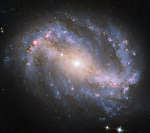 Barred Spiral Galaxy NGC 6217
28.12.2009
Many spiral galaxies have bars across their centers. Even our own Milky Way Galaxy is thought to have a modest central bar. Prominently barred spiral galaxy NGC 6217, pictured above, was captured in spectacular detail in this recently released image taken by the newly repaired Advanced Camera for Surveys on the orbiting Hubble Space Telescope.
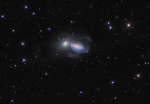 Arp 94
9.10.2013
This telescopic snapshot records a cosmic moment in the tumultuous lives of large spiral galaxy NGC 3227 and smaller elliptical NGC 3226. Catching them in the middle of an ongoing gravitational dance, the sensitive imaging also follows faint tidal star streams flung from the galaxies in their repeated close encounters.
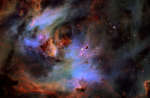 Globules in the Running Chicken Nebula
5.03.2014
The eggs from this chicken may form into stars. The above pictured emission nebula, cataloged as IC 2944, is called the Running Chicken Nebula for the shape of its greater appearance. The image was taken recently from Siding Spring Observatory in Australia and presented in scientifically assigned colors.
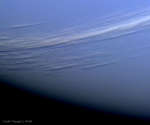 Two Hours Before Neptune
14.02.2015
Two hours before closest approach to Neptune in 1989, the Voyager 2 robot spacecraft snapped this picture. Clearly visible for the first time were long light-colored cirrus-type clouds floating high in Neptune's atmosphere. Shadows of these clouds can even be seen on lower cloud decks.
|
January February March April May June July August September October |
|||||||||||||||||||||||||||||||||||||||||||||||||