
|
You entered: light
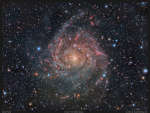 IC 342: The Hidden Galaxy in Camelopardalis
11.02.2022
Similar in size to large, bright spiral galaxies in our neighborhood, IC 342 is a mere 10 million light-years distant in the long-necked, northern constellation Camelopardalis. A sprawling island universe, IC 342 would otherwise...
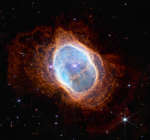 Webb s Southern Ring Nebula
14.07.2022
Cataloged as NGC 3132 the Southern Ring Nebula is a planetary nebula, the death shroud of a dying sun-like star some 2,500 light-years from Earth. Composed of gas and dust the stunning cosmic landscape is nearly half a light-year in diameter, explored in unprecedented detail by the James Webb Space Telescope.
 IC 342: Hidden Galaxy in Camelopardalis
22.11.2023
Similar in size to large, bright spiral galaxies in our neighborhood, IC 342 is a mere 10 million light-years distant in the long-necked, northern constellation Camelopardalis. A sprawling island universe, IC 342 would otherwise...
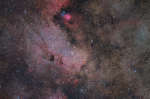 Messier 24: Sagittarius Star Cloud
18.07.2024
Unlike most entries in Charles Messier's famous catalog of deep sky objects, M24 is not a bright galaxy, star cluster, or nebula. It's a gap in nearby, obscuring interstellar dust clouds that allows a view of the distant stars in the Sagittarius spiral arm of our Milky Way galaxy.
 APOD: 2025 July 21 Б Cats Paw Nebula from Webb Space Telescope
21.07.2025
Nebulas are perhaps as famous for being identified with familiar shapes as perhaps cats are for getting into trouble. Still, no known cat could have created the vast Cat's Paw Nebula visible toward the constellation of the Scorpion (Scorpius).
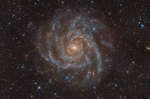 IC 342: Hidden Galaxy in Camelopardalis
8.01.2026
Similar in size to large, bright spiral galaxies in our neighborhood, IC 342 is a mere 10 million light-years distant toward the long-necked, northern constellation Camelopardalis. A sprawling island universe, IC 342 would otherwise...
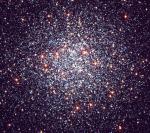 M55: Globular Star Cluster
22.09.2000
The fifty-fifth entry in Charles Messier's catalog, M55 is a large and lovely globular cluster of around 100,000 stars. Only 20,000 light-years away in the constellation Sagittarius, M55 appears to earth-bound observers to be nearly 2/3 the size of the full moon.
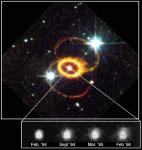 Supernova 1987a Fireball Resolved
24.01.1997
Ten years ago the most notable supernova of modern times was observed. In February 1987, light reached Earth from a star which exploded in the nearby Large Magellanic Cloud galaxy. Supernova 1987a remains the closest supernova since the invention of the telescope.
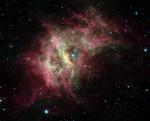 Cosmic Construction Zone RCW 49
3.06.2004
Stars and planets appear to be under construction in dusty nebula RCW 49. This Spitzer Space Telescope false-color infrared view of the nearby stellar nursery shows that known, hot stars are well on their way to clearing out the nebula's central regions.
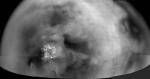 Titan Through the Haze
26.10.2004
What are these surface features on Titan? This planet-sized moon of Saturn had much of its south polar surface imaged during an initial flyby by the Saturn-orbiting Cassini spacecraft back in early July.
|
January February March April May June July August September October |
|||||||||||||||||||||||||||||||||||||||||||||||||