
|
You entered: light
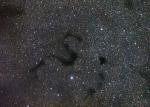 Snake in the Dark
21.05.2005
Dark nebulae snake across a gorgeous expanse of stars in this wide-field view toward the pronounceable constellation Ophiucus and the center of our Milky Way Galaxy. In fact, the central S-shape seen here is well known as the Snake Nebula.
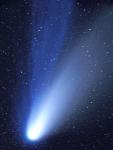 The Dust and Ion Tales of Comet Hale-Bopp
22.05.2005
In 1997, Comet Hale-Bopp's intrinsic brightness exceeded any comet since 1811. Since it peaked on the other side of the Earth's orbit, however, the comet appeared only brighter than any comet in two decades. Visible above are the two tails shed by Comet Hale-Bopp.
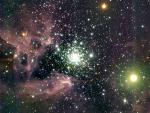 NGC 3603: An Active Star Cluster
18.10.1999
NGC 3603 is home to a massive star cluster, thick dust pillars, and a star about to explode. The central open cluster contains about 2000 bright stars, each of which is much brighter and more massive than our Sun.
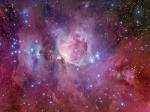 M42: Wisps of the Orion Nebula
20.11.2006
The Great Nebula in Orion, an immense, nearby starbirth region, is probably the most famous of all astronomical nebulas. Here, glowing gas surrounds hot young stars at the edge of an immense interstellar molecular cloud only 1500 light-years away. In the above deep image, faint wisps and sheets of dust and gas are particularly evident.
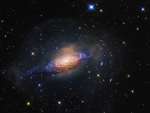 NGC 3521: Galaxy in a Bubble
15.09.2011
Gorgeous spiral galaxy NGC 3521 is a mere 35 million light-years away, toward the constellation Leo. Relatively bright in planet Earth's sky, NGC 3521 is easily visible in small telescopes but often overlooked by amateur imagers in favor of other Leo spiral galaxies, like M66 and M65.
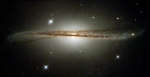 Warped Spiral Galaxy ESO 510 13
4.03.2012
How did spiral galaxy ESO 510-13 get bent out of shape? The disks of many spirals are thin and flat, but not solid. Spiral disks are loose conglomerations of billions of stars and diffuse gas all gravitationally orbiting a galaxy center.
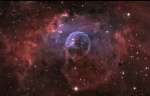 The Bubble Nebula
14.12.2013
Blown by the wind from a massive star, this interstellar apparition has a surprisingly familiar shape. Cataloged as NGC 7635, it is also known simply as The Bubble Nebula. Although it looks delicate, the 10 light-year diameter bubble offers evidence of violent processes at work.
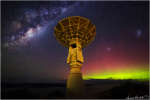 Satellite Station and Southern Skies
31.05.2014
This clear night skyscape captures the colorful glow of aurora australis, the southern lights, just outside the port city of Hobart, Tasmania, Australia, planet Earth. As if staring into the dreamlike scene, the Tasmanian Earth Resources Satellite Station poses in the center, illuminated by nearby city lights.
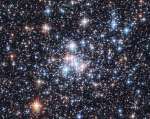 Open Cluster NGC 290: A Stellar Jewel Box
8.06.2014
Jewels don't shine this bright -- only stars do. Like gems in a jewel box, though, the stars of open cluster NGC 290 glitter in a beautiful display of brightness and color. The photogenic cluster, pictured above, was captured recently by the orbiting Hubble Space Telescope.
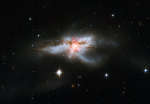 NGC 6240: Merging Galaxies
21.05.2015
NGC 6240 offers a rare, nearby glimpse of a cosmic catastrophe in its final throes. The titanic galaxy-galaxy collision takes place a mere 400 million light-years away in the constellation Ophiuchus. The merging galaxies spew distorted tidal tails of stars, gas, and dust and undergo fast and furious bursts of star formation.
|
January February March April May June July August September October |
|||||||||||||||||||||||||||||||||||||||||||||||||