
|
You entered: telescope
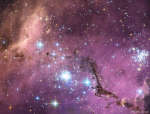 N11: Star Clouds of the LMC
29.04.2019
Massive stars, abrasive winds, mountains of dust, and energetic light sculpt one of the largest and most picturesque regions of star formation in the Local Group of Galaxies. Known as N11, the region...
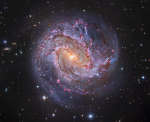 M83: The Thousand Ruby Galaxy
29.06.2019
Big, bright, and beautiful, spiral galaxy M83 lies a mere twelve million light-years away, near the southeastern tip of the very long constellation Hydra. Prominent spiral arms traced by dark dust lanes and blue star clusters lend this galaxy its popular name, The Southern Pinwheel.
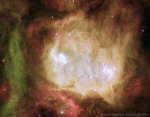 Halloween and the Ghost Head Nebula
24.10.2021
Halloween's origin is ancient and astronomical. Since the fifth century BC, Halloween has been celebrated as a cross-quarter day, a day halfway between an equinox (equal day / equal night) and a solstice (minimum day / maximum night in the northern hemisphere).
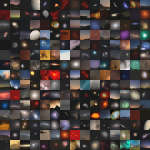 All of These Space Images are Fake Except One
9.11.2021
Why would you want to fake a universe? For one reason -- to better understand our real universe. Many astronomical projects seeking to learn properties of our universe now start with a robotic telescope taking sequential images of the night sky.
 APOD: 2023 May 8 Б The Spanish Dancer Spiral Galaxy
8.05.2023
If not perfect, then this spiral galaxy is at least one of the most photogenic. An island universe containing billions of stars and situated about 40 million light-years away toward the constellation of the Dolphinfish (Dorado), NGC 1566 presents a gorgeous face-on view.
 Galaxy Cluster Abell 370 and Beyond
12.09.2023
Some 4 billion light-years away, massive galaxy cluster Abell 370 is captured in this sharp Hubble Space Telescope snapshot. The cluster of galaxies only appears to be dominated by two giant elliptical galaxies and infested with faint arcs.
 APOD: 2025 April 29 Б Saturns Rings Appear to Disappear
29.04.2025
Where are Saturn's ears? Galileo is credited, in 1610, as the first person to see Saturn's rings. Testing out Lipperhey's recently co-invented telescope, Galileo did not know what they were and so called them "ears". The mystery deepened in 1612, when Saturn's ears mysteriously disappeared.
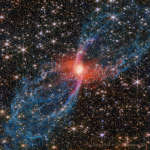 APOD: 2026 February 3 Б Red Spider Planetary Nebula from Webb
3.02.2026
Oh what a tangled web a planetary nebula can weave. The Red Spider Planetary Nebula shows the complex structure that can result when a normal star ejects its outer gases and becomes a white dwarf star.
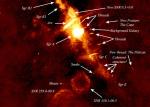 The Galactic Center A Radio Mystery
28.01.1999
Tuning in to the center of our Milky Way galaxy, radio astronomers explore a complex, mysterious place. A premier high resolution view, this startlingly beautiful picture covers a 4x4 degree region around the galactic center.
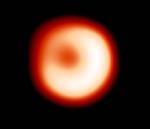 LkHa101: The Hole in the Doughnut
2.03.2001
You'd need a really big cup of coffee with this doughnut ... because the hole in the middle is about a billion kilometers across. Centered on the Sun, a circle that size would lie between the orbits of Mars and Jupiter.
|
January February March April May June July August September October |
|||||||||||||||||||||||||||||||||||||||||||||||||