
|
You entered: telescope
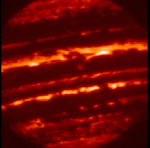 Beneath Jupiter's Clouds
23.01.1996
This near-infrared image of Jupiter was made using instrumentation at NASA's Infrared Telescope Facility, located on the summit of Mauna Kea, Hawaii, in support of the Galileo mission to Jupiter. The brightest spots...
 Eris: The Largest Known Dwarf Planet
18.09.2006
Is Pluto the largest dwarf planet? No! Currently, the largest known dwarf planet is (136199) Eris, renamed last week from 2003 UB313. Eris is just slightly larger than Pluto, but orbits as far as twice Pluto's distance from the Sun.
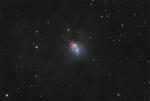 Dusty NGC 1300
6.10.2006
Dusty NGC 1333 is seen in visible light as a reflection nebula, dominated by bluish hues characteristic of starlight reflected by dust. But at longer infrared wavelengths, the interstellar dust itself glows. Moving your...
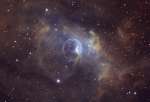 The Bubble Nebula
2.09.2010
Blown by the wind from a massive star, this interstellar apparition has a surprisingly familiar shape. Cataloged as NGC 7635, it is also known simply as The Bubble Nebula. Although it looks delicate, the 10 light-year diameter bubble offers evidence of violent processes at work.
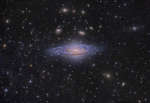 NGC 7331 and Beyond
17.12.2014
Big, beautiful spiral galaxy NGC 7331 is often touted as an analog to our own Milky Way. About 50 million light-years distant in the northern constellation Pegasus, NGC 7331 was recognized early on as a spiral nebula and is actually one of the brighter galaxies not included in Charles Messier's famous 18th century catalog.
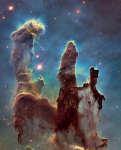 Hubble 25th Anniversary: Pillars of Creation
6.01.2015
To celebrate 25 years (1990-2015) of exploring the Universe from low Earth orbit, the Hubble Space Telescope's cameras were used to revisit its most iconic image. The result is this sharper, wider view of the region dubbed the Pillars of Creation, first imaged by Hubble in 1995.
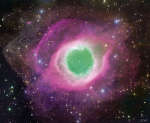 The Helix Nebula from CFHT
3.01.2018
Will our Sun look like this one day? The Helix Nebula is one of brightest and closest examples of a planetary nebula, a gas cloud created at the end of the life of a Sun-like star.
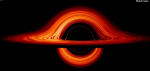 APOD: 2020 August 25 Б Visualization: A Black Hole Accretion Disk
25.08.2020
What would it look like to circle a black hole? If the black hole was surrounded by a swirling disk of glowing and accreting gas, then the great gravity of the black hole would deflect light emitted by the disk to make it look very unusual. The featured animated video gives a visualization.
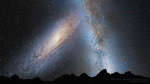 Milky Way Galaxy Doomed: Collision with Andromeda Pending
6.06.2022
Will our Milky Way Galaxy collide one day with its larger neighbor, the Andromeda Galaxy? Most likely, yes. Careful plotting of slight displacements of M31's stars relative to background galaxies on recent Hubble...
 NGC 253: Dusty Island Universe
15.02.2024
Shiny NGC 253 is one of the brightest spiral galaxies visible, and also one of the dustiest. Some call it the Silver Coin Galaxy for its appearance in small telescopes, or just the Sculptor Galaxy for its location within the boundaries of the southern constellation Sculptor.
|
January February March April May June July August September October |
|||||||||||||||||||||||||||||||||||||||||||||||||