
|
You entered: galaxies
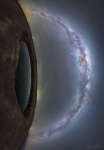 Eye on the Milky Way
21.04.2020
Have you ever had stars in your eyes? It appears that the eye on the left does, and moreover it appears to be gazing at even more stars. The featured 27-frame mosaic was taken last July from Ojas de Salar in the Atacama Desert of Chile.
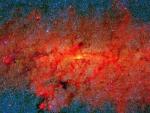 The Galactic Center Across the Infrared
7.07.2002
The center of our Galaxy is obscured in visible light by dark dust that rotates with the stars in the Galactic Plane. In this century, however, sensors have been developed that can detect light more red that humans can see - light called infrared.
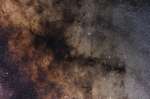 East of Antares
22.05.2009
East of Antares, dark markings sprawl through crowded star fields toward the center of our Milky Way Galaxy. Cataloged in the early 20th century by astronomer E. E. Barnard, the obscuring interstellar dust clouds include B59, B72, B77 and B78, seen in silhouette against the starry background.
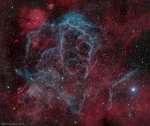 Vela Supernova Remnant
10.09.2010
The plane of our Milky Way Galaxy runs through this complex and beautiful skyscape. At the northwestern edge of the constellation Vela (the Sails) the four frame mosaic is over 10 degrees wide, centered on the glowing filaments of the Vela Supernova Remnant, the expanding debris cloud from the death explosion of a massive star.
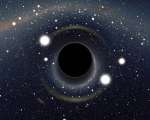 Too Close to a Black Hole
26.10.2014
What would you see if you went right up to a black hole? Featured is a computer generated image highlighting how strange things would look. The black hole has such strong gravity that light is noticeably bent towards it - causing some very unusual visual distortions.
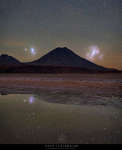 Magellanic Mountain
28.04.2018
Flanked by satellite galaxies of the Milky Way a volcanic peak rises from this rugged horizon. The southern night skyscape looks toward the south over Laguna Lejia and the altiplano of the Antofagasta Region of northern Chile.
 APOD: 2025 September 5 Б 47 Tucanae: Globular Star Cluster
5.09.2025
Also known as NGC 104, 47 Tucanae is a jewel of the southern sky. Not a star but a dense cluster of stars, it roams the halo of our Milky Way Galaxy along with some 200 other globular star clusters.
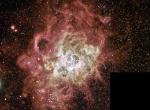 NGC 604: Giant Stellar Nursery
9.12.2003
Stars are sometimes born in the midst of chaos. About 3 million years ago in the nearby galaxy M33, a large cloud of gas spawned dense internal knots which gravitationally collapsed to form stars. NGC 604 was so large, however, it could form enough stars to make a globular cluster.
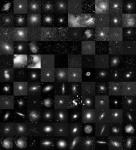 Messier Marathon
18.03.1999
Gripped by an astronomical spring fever, this week many amateur stargazers embark on a Messier Marathon. The Vernal Equinox occurs Saturday, March 20, marking the first day of Spring for the Northern Hemisphere.
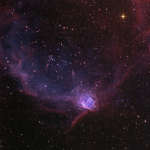 NGC 602 in the Flying Lizard Nebula
6.03.2015
Near the outskirts of the Small Magellanic Cloud, a satellite galaxy some 200 thousand light-years distant, lies 5 million year young star cluster NGC 602. Surrounded by natal gas and dust, NGC 602 is just below center in this telescopic field of view with the angular size of the Full Moon on the sky.
|
January February March April May June July August September October |
|||||||||||||||||||||||||||||||||||||||||||||||||