
|
You entered: galaxies
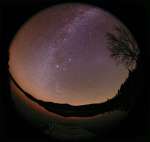 Zodiacal Light and Milky Way
20.10.2012
Ghostly apparitions of two fundamental planes in planet Earth's sky span this October all-sky view. The scene was captured from a lakeside campsite under dark skies in northern Maine, USA. In it, the plane of our Milky Way Galaxy arcs above faint airglow along the horizon.
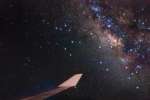 New York to London Milky Way
14.06.2014
Bright stars of Sagittarius and the center of our Milky Way Galaxy lie just off the wing of a Boeing 747 in this astronomical travel photo. The stratospheric scene was captured earlier this month during a flight from New York to London, 11,0000 meters above the Atlantic Ocean.
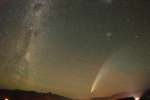 Comet McNaught Over New Zealand
19.10.2014
Comet McNaught was perhaps the most photogenic comet of modern times -- from Earth. After making quite a show in the northern hemisphere in early January of 2007, the comet moved south and developed a long and unusual dust tail that dazzled southern hemisphere observers.
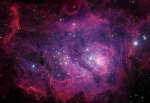 The Wide and Deep Lagoon
9.09.2016
Ridges of glowing interstellar gas and dark dust clouds inhabit the turbulent, cosmic depths of the Lagoon Nebula. Also known as M8, the bright star forming region is about 5,000 light-years distant.
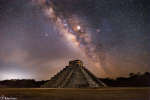 APOD: 2023 March 19 Б Equinox at the Pyramid of the Feathered Serpent
19.03.2023
To see the feathered serpent descend the Mayan pyramid requires exquisite timing. You must visit El Castillo -- in Mexico's Yucatцn Peninsula -- near an equinox. Then, during the late afternoon if the sky is clear, the pyramid's own shadows create triangles that merge into the famous illusion of a slithering viper.
 APOD: 2025 November 26 Б Globular Cluster M15 Deep Field
26.11.2025
Stars, like bees, swarm around the center of bright globular cluster M15. The central ball of over 100,000 stars is a relic from the early years of our Galaxy, and continues to orbit the Milky Way's center.
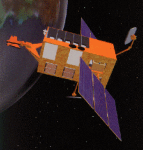 The X-ray Timing Explorer
3.01.1996
Launched Saturday on a Delta rocket, the X-ray Timing Explorer (XTE) will watch the sky for rapid changes in X-rays. XTE carries three separate X-ray telescopes. The Proportional Counter Array (PCA) and the High Energy X-ray Timing Experiment (HEXTE) will provide the best timing information in the widest X-ray energy range yet available.
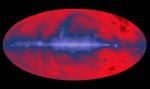 The Radio Sky: Tuned to 408MHz
5.02.2005
Tune your radio telescope to 408MHz (408 million cycles per second) and check out the Radio Sky! In the 1970s large dish antennas at three radio observatories, Jodrell Bank, MPIfR, and Parkes Observatory, were used to do just that - the data were combined to map the entire sky.
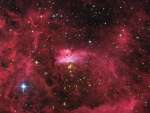 Massive Stars in NGC 6357
9.10.2008
Massive Stars lie within NGC 6357, an expansive emission nebula complex some 8,000 light-years away in the tail of the constellation Scorpius. In fact, positioned just below center in this close-up view...
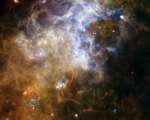 Herschel Views the Milky Way
16.10.2009
With a 3.5 meter diameter mirror, larger than the Hubble Space Telescope, Herschel is ESA's new infrared observatory. The space-based telescope is named for German-born British astronomer Frederick William Herschel who discovered infrared light over 200 years ago.
|
January February March April May June July August September October |
|||||||||||||||||||||||||||||||||||||||||||||||||