
|
You entered: galaxies
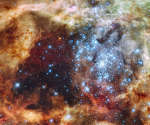 Star Cluster R136 Bursts Out
29.07.2012
In the center of star-forming region 30 Doradus lies a huge cluster of the largest, hottest, most massive stars known. These stars, known collectively as star cluster R136, were captured above in visible light by the newly installed Wide Field Camera peering though the recently refurbished Hubble Space Telescope.
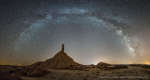 Milky Way Over Spains Bardenas Reales
2.09.2013
What's that below the Milky Way? First, across the top of the above image, lies the faint band that is our planet's sideways view of the central disk of our home Milky Way Galaxy.
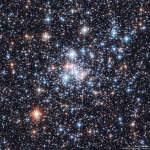 A Stellar Jewel Box: Open Cluster NGC 290
13.10.2019
Jewels don't shine this bright -- only stars do. Like gems in a jewel box, though, the stars of open cluster NGC 290 glitter in a beautiful display of brightness and color. The photogenic cluster, pictured here, was captured in 2006 by the orbiting Hubble Space Telescope.
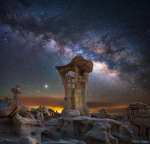 APOD: 2020 August 13 Б Jupiter and Saturn Rising Beyond Alien Throne Rock
13.08.2020
Whatбplanets are those behind that unusualбrock spire? Saturn (lower left) and Jupiter.б This month, after sunset, the bright planetary duo are quite prominent toward the southeast.б Now your view of our Solar...
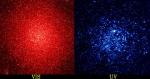 Globular Cluster Omega Centauri
15.10.2000
Does an old, red globular cluster have any hot, blue stars? The rightmost picture, taken by the Ultraviolet Imaging Telescope in ultraviolet light, shows that indeed it does. Pictured, Omega Centauri is the largest known globular cluster of over 200 in our Galaxy, containing well over a million stars.
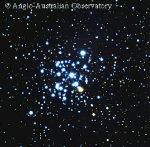 NGC 3293: A Bright Young Open Cluster
29.03.1998
Hot blue stars shine brightly in this beautiful, recently formed galactic or "open" star cluster. Open cluster NGC 3293 is located in the constellation Carina, lies at a distance of about 8000 light years, and has a particularly high abundance of these young bright stars.
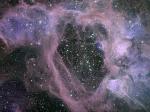 The N44 Superbubble
6.02.2006
What created this gigantic hole? The vast emission nebula N44 in our neighboring galaxy the Large Magellanic Cloud has a large, 250 light-year hole and astronomers are trying to figure out why. One possibility is particle winds expelled by massive stars in the bubble's interior that are pushing out the glowing gas.
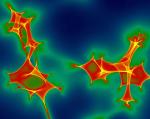 A Network of Microlensing Caustics
24.08.1999
A virtual sky map like this would be of interest to astronomers studying gravitational microlensing. In microlensing, the gravity of stars near the line of sight can act to magnify the light of background objects such as distant stars, or quasars. Nowhere is this magnification greater than near a gravitational lensing caustic.
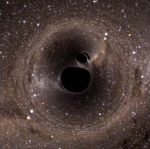 When Black Holes Collide
20.10.2015
What happens when two black holes collide? This extreme scenario likely occurs in the centers of some merging galaxies and multiple star systems. The featured video shows a computer animation of the final stages of such a merger, while highlighting the gravitational lensing effects that would appear on a background starfield.
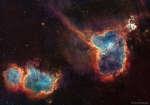 The Heart and Soul Nebulas
16.11.2016
Is the heart and soul of our Galaxy located in Cassiopeia? Possibly not, but that is where two bright emission nebulas nicknamed Heart and Soul can be found. The Heart Nebula, officially dubbed IC 1805 and visible in the featured image on the right, has a shape reminiscent of a classical heart symbol.
|
January February March April May June July August September October |
|||||||||||||||||||||||||||||||||||||||||||||||||