
|
You entered: planets
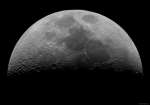 The Lunar X
1.03.2018
The striking X in this lunarscape is easily visible in binoculars or a small telescope, but not too many have seen it. The catch is, this lunar X is fleeting and only apparent in the hours before the Moon's first quarter phase.
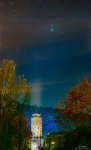 December s Comet Wirtanen
7.12.2018
Coming close in mid-December, Comet 46P Wirtanen hangs in this starry sky over the bell tower of a Romanesque church. In the constructed vertical panorama, a series of digital exposures capture its greenish coma on December 3 from Sant Llorenc de la Muga, Girona, Catalonia, Spain, planet Earth.
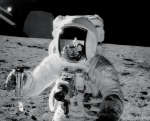 Apollo 12: Self Portrait
24.11.2019
Is this image art? 50 years ago, Apollo 12 astronaut-photographer Charles "Pete" Conrad recorded this masterpiece while documenting colleague Alan Bean's lunar soil collection activities on Oceanus Procellarum. The featured image is dramatic and stark.
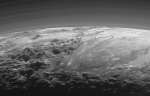 A Plutonian Landscape
15.01.2021
This shadowy landscape of majestic mountains and icy plains stretches toward the horizon on a small, distant world. It was captured from a range of about 18,000 kilometers when New Horizons looked back toward Pluto, 15 minutes after the spacecraft's closest approach on July 14.
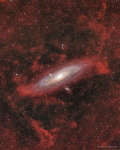 Clouds Around Galaxy Andromeda
24.10.2022
What are those red clouds surrounding the Andromeda galaxy? This galaxy, M31, is often imaged by planet Earth-based astronomers. As the nearest large spiral galaxy, it is a familiar sight with dark dust lanes, bright yellowish core, and spiral arms traced by clouds of bright blue stars.
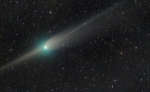 Comet ZTF: Orbital Plane Crossing
27.01.2023
The current darling of the northern night, Comet C/2022 E3 ZTF is captured in this telescopic image from a dark sky location at June Lake, California. Of course Comet ZTF has been growing brighter in recent days, headed for its closest approach to Earth on February 1.
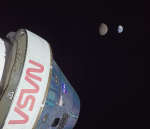 Artemis I: Flight Day 13
31.01.2026
On flight day 13 (November 28, 2022) of the Artemis 1 mission, the Orion spacecraft reached its maximum distance from Earth. At over 430,000 kilometers from Earth, its distant retrograde orbit also puts Orion nearly 70,000 kilometers from the Moon.
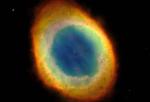 M57: The Ring Nebula
16.07.2000
Except for the rings of Saturn, The Ring Nebula (M57) is probably the most famous celestial band. This planetary nebula's simple, graceful appearance is thought to be due to perspective -- our view from planet Earth looking straight into what is actually a barrel-shaped cloud of gas shrugged off by a dying central star.
 Eclipse in African Skies
22.06.2001
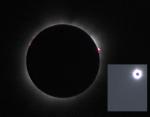
Yesterday, for a brief few minutes, a total eclipse of the Sun brought darkness to southern Africa's daytime skies. During this first total solar eclipse of the third millennium webcast sites were swamped, but sun-watchers along the eclipse path enjoyed clear weather and reported fantastic views.
 Apollo 17s Moonship
15.04.1999
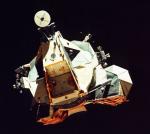
Awkward and angular looking, Apollo 17's lunar module Challenger was designed for flight in the vacuum of space. This sharp picture from the command module America, shows Challenger's ascent stage in lunar orbit.
|
January February March April May June July August September October |
|||||||||||||||||||||||||||||||||||||||||||||||||