
|
You entered: planets
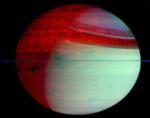 Saturn s Infrared Glow
12.10.2006
Known for its bright ring system and many moons, gas giant Saturn looks strange and unfamiliar in this false-color view from the Cassini spacecraft. In fact, in this Visual and Infrared Mapping Spectrometer (VIMS) mosaic the famous rings are almost invisible, seen edge-on cutting across picture center.
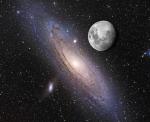 Moon Over Andromeda
28.12.2006
The Great Spiral Galaxy in Andromeda (aka M31), a mere 2.5 million light-years distant, is the closest large spiral to our own Milky Way. Andromeda is visible to the unaided eye as a small...
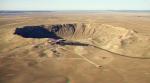 3D Barringer Meteorite Crater
23.06.2007
Baringer Meteorite Crater, near Winslow, Arizona, is one of the best known impact craters on planet Earth. View this color stereo anaglyph with red/blue glasses to get a dramatic sense of the crater's dimensions -- one mile wide, and up to 570 feet deep.
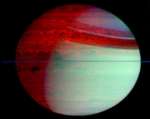 Saturn s Infrared Glow
29.12.2007
(xxxedit and linkxxx) Known for its bright ring system and many moons, gas giant Saturn looks strange and unfamiliar in this false-color view from the Cassini spacecraft. In fact, in this Visual and Infrared Mapping Spectrometer (VIMS) mosaic the famous rings are almost invisible, seen edge-on cutting across picture center.
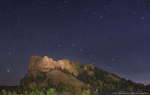 Mount Rushmore s Starry Night
4.07.2009
This starry night sky sparkles above the Black Hills of South Dakota and the United States' Mount Rushmore National Park. The historic site features enormous sculptures of four US presidents; George Washington, Thomas Jefferson, Theodore Roosevelt and Abraham Lincoln, carved into the southeast face of granite cliffs.
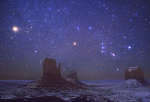 Mars and Orion over Monument Valley
2.02.2014
Welcome to The World At Night. Sharing the night sky seen around the world, this view from Monument Valley, USA includes a picturesque foreground of famous buttes. Buttes are composed of hard rock left behind after water eroded away the surrounding soft rock.
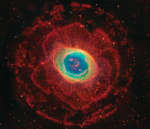 Rings Around the Ring Nebula
13.08.2014
It is a familiar sight to sky enthusiasts with even a small telescope. There is much more to the Ring Nebula (M57), however, than can be seen through a small telescope. The easily visible...
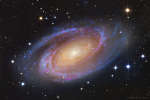 Bright Spiral Galaxy M81
18.11.2014
One of the brightest galaxies in planet Earth's sky is similar in size to our Milky Way Galaxy: big, beautiful M81. This grand spiral galaxy can be found toward the northern constellation of the Great Bear (Ursa Major).
 West Coast Launch and Landing
11.10.2018
A SpaceX Falcon 9 rocket launch dazzled viewers along the U.S. west coast after sunset on October 7. Rising from Vandenberg Air Force Base, California, planet Earth, the Falcon 9's first stage then returned to a landing zone some 400 meters from the launch site less than 8 minutes after liftoff.
 Touchdown on Asteroid Ryugu
12.03.2019
Last month, humanity bounced a robot off an asteroid. The main reason was to collect a surface sample. Despite concern over finding a safely reboundable touchdown spot, Japan's robotic Hayabusa2 spacecraft successfully touched down -- and bounced right back from -- asteroid Ryugu.
|
January February March April May June July August September October |
|||||||||||||||||||||||||||||||||||||||||||||||||