
|
You entered: planets
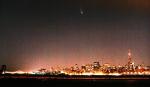 The City Comet
26.03.1997
Undaunted by the artificial glow from one of the most famous urban skylines on Earth, comet Hale-Bopp shines above the city of New York, USA. Photographed on March 23rd, this view from New Jersey...
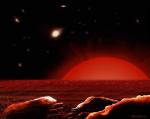 Stars Without Galaxies
15.02.1998
Galaxies are made up of stars, but are all stars found within galaxies? Using the Hubble Space Telescope, researchers exploring the Virgo Cluster of galaxies have now found about 600 red giant stars adrift in intergalactic space. Above is an artist's vision of the sky from a hypothetical planet of such a lonely sun.
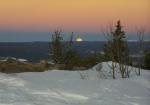 Shadow Set
27.01.2005
A nearly full Moon and planet Earth's shadow set together in this scene captured Monday from snowy Mt. Jelm, home of the Wyoming Infrared Observatory. For early morning risers (and late...
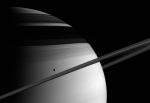 Tethys, Rings, and Shadows
22.07.2005
Seen from ice moon Tethys, rings and shadows would play across fantastic views of the Saturnian system. Haven't dropped in on Tethys lately? Then this gorgeous ringscape from the Cassini spacecraft will have to do for now.
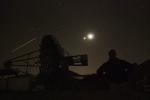 VERITAS and Venus
8.11.2007
Early morning risers and late to bed astronomers have recently enjoyed bright planets in predawn skies, with brilliant Venus above the eastern horizon. On November 5, Venus was joined by the waning crescent Moon.
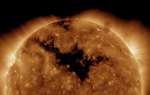 Hole in the Sun
28.08.2010
This ominous, dark shape sprawling across the face of the Sun is a coronal hole -- a low density region extending above the surface where the solar magnetic field opens freely into interplanetary space. Studied...
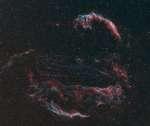 The Veil Nebula
16.09.2010
Delicate in appearance, these filaments of shocked, glowing gas, draped in planet Earth's sky toward the constellation of Cygnus, make up the Veil Nebula. The nebula is a large supernova remnant, an expanding cloud born of the death explosion of a massive star.
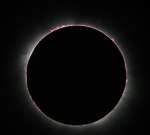 Solar Eclipse from Uganda
8.11.2013
The Sun's disk was totally eclipsed for a brief 20 seconds as the Moon's dark umbral shadow raced across Pokwero in northwestern Uganda on November 3rd. So this sharp telescopic view of totality in clear skies from the central African locale was much sought after by eclipse watchers.
 Opportunity s Decade on Mars
25.01.2014
On January 25 (UT) 2004, the Opportunity rover fell to Mars, making today the 10th anniversary of its landing. After more than 3,500 sols (Mars solar days) the golf cart-sized robot from Earth is still actively exploring the Red Planet, though its original mission plan was for three months.
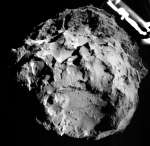 Descent to a Comet
12.11.2014
Yesterday, the first soft landing on a comet took place some 500 million kilometers from planet Earth as the Rosetta mission lander Philae settled on the nucleus of C67/P Churyumov-Gerasimenko. The landing site, dubbed Agilkia, is located near the center of this remarkable image snapped by Philae's ROLIS (ROsetta Lander Imaging System) camera.
|
January February March April May June July August September October |
|||||||||||||||||||||||||||||||||||||||||||||||||