
|
You entered: rings
 APOD: 2024 December 17 Б Near to the Heart Nebula
17.12.2024
What excites the Heart Nebula? First, the large emission nebula on the upper left, catalogued as IC 1805, looks somewhat like a human heart. The nebula glows brightly in red light emitted by its most prominent element, hydrogen, but this long-exposure image was also blended with light emitted by sulfur (yellow) and oxygen (blue).
 The Variable Nebula NGC 2261
31.01.2025
The interstellar cloud of dust and gas captured in this sharp telescopic snapshot is seen to change its appearance noticeably over periods as short as a few weeks. Discovered over 200 years ago and cataloged as NGC 2261, bright star R Monocerotis lies at the tip of the fan-shaped nebula.
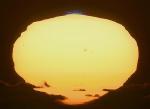 Blue Flash
9.01.2002
Difficult to observe, the momentary green flash above the rising or setting sun has been documented as a phenomenon caused by the atmospheric bending or refraction of sunlight. Like a weak prism, the Earth's atmosphere breaks white sunlight into colors, bending red colors slightly and green and blue colors through increasingly larger angles.
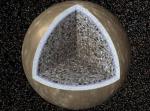 Cutaway Callisto: Ice, Rock, and Ocean
6.11.1998
Cruising past the moons of reigning gas giant Jupiter, Voyager and Galileo have returned tantalizing evidence for a liquid water ocean beneath the surface of Europa. Now researchers are reporting telltale indications that the battered Jovian moon Callisto may also harbor a subsurface
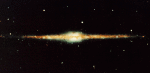 The Milky Way's Center
15.03.1997
Although the Earth is round, our Galaxy appears truly flat. This was shown in dramatic fashion by the COsmic Background Explorer (COBE) satellite which produced this premier view of the central region of our own Milky Way Galaxy in infrared light in1990.
 Valles Marineris Perspective from Mars Express
29.01.2004
Europe's Mars Express satellite has started returning detailed color images of the red planet. The first of the current armada to arrive at Mars, the orbiting satellite will photograph the entire Martian surface...
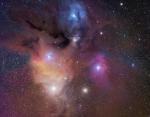 The Colorful Clouds of Rho Ophiuchi
14.07.2006
This stunning mosiac of the sky around bright stars Antares (Alpha Scorpii) and Rho Ophiuchi reveals spectacular colors in a cosmic starscape. Near the top, Rho Ophiuchi and nearby stars are immersed in blue reflection nebulae - dust clouds that shine primarily by reflected starlight.
 Shaping NGC 6188
2.05.2008
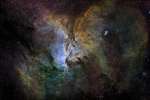
Dark shapes with bright edges winging their way through dusty NGC 6188 are tens of light-years long. The emission nebula is found near the edge of an otherwise dark large molecular cloud in the southern constellation Ara, about 4,000 light-years away.
 Horsehead and Orion Nebulas
29.10.2013
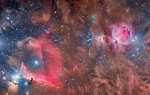
The dark Horsehead Nebula and the glowing Orion Nebula are contrasting cosmic vistas. Adrift 1,500 light-years away in one of the night sky's most recognizable constellations, they appear in opposite corners of the above stunning mosaic.
 Surprising Comet ISON
30.11.2013
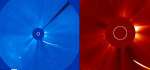
After failing to appear for Sun staring spacecraft at perihelion, its harrowing closest approach to the Sun, sungrazing Comet ISON was presumed lost. But ISON surprised observers yesterday as material still traveling along the comet's trajectory became visible and even developed an extensive fan-shaped dust tail.
|
January February March April May June July August September October |
|||||||||||||||||||||||||||||||||||||||||||||||||