
|
You entered: rings
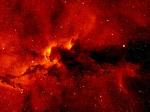 IC 1396 Close Up
30.09.2005
Clouds of glowing hydrogen gas mingle ominously with dark dust lanes in this close-up of IC 1396, an active star forming region some 2,000 light years away in the constellation Cepheus. In this and other similar emission nebulae, energetic ultraviolet light from a hot young star strips electrons from the surrounding hydrogen atoms.
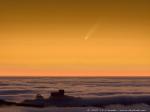 Comet McNaught Over Catalonia
14.01.2007
This past weekend Comet McNaught peaked at a brightness that surpassed even Venus. Fascinated sky enthusiasts in the Earth's northern hemisphere were treated to an instantly visible comet head and a faint elongated tail near sunrise and sunset.
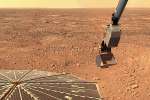 Phoenix Digs for Clues on Mars
15.06.2008
What's a good recipe for preparing Martian soil? Start by filling your robot's scoop a bit less than half way. Next, dump your Martian soil into one of your TEGA ovens, being sure to watch out for clumping. Then, slowly increase the temperature to over 1000 degrees Celsius over several days.
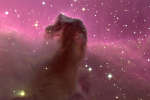 The Horsehead Nebula
21.07.2009
One of the most identifiable nebulae in the sky, the Horsehead Nebula in Orion, is part of a large, dark, molecular cloud. Also known as Barnard 33, the unusual shape was first discovered on a photographic plate in the late 1800s.
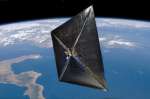 NanoSail D
27.01.2011
Featured in this artist's illustration, NASA's NanoSail-D finally unfurled a very thin, 10 square meter reflective sail on January 20th, becoming the first solar sail spacecraft in low Earth orbit. Often considered...
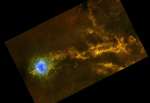 Herschel s Cocoon
19.08.2011
In this remarkable infrared skyscape of interstellar clouds adrift in the high flying constellation Cygnus, the eye is drawn to the Cocoon Nebula. Also known as IC5146, the dusty star forming region is shown...
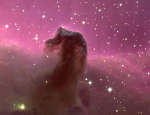 The Horsehead Nebula
21.10.2012
One of the most identifiable nebulae in the sky, the Horsehead Nebula in Orion, is part of a large, dark, molecular cloud. Also known as Barnard 33, the unusual shape was first discovered on a photographic plate in the late 1800s.
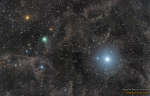 Polaris and Comet Lovejoy
1.06.2015
One of these two bright sky objects is moving. On the right is the famous star Polaris. Although only the 45th brightest star in the sky, Polaris is famous for appearing stationary. Once you find it, it will always appear in the same direction -- all night and all day -- for the rest of your life.
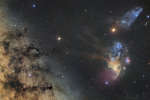 Saturn and Mars visit Milky Way Star Clouds
9.05.2016
Planets, stars, nebulas and a galaxy -- this impressive image has them all. Closest to home are the two planets Mars (right) and Saturn (center), visible as the two bright orange spots in the upper half of the featured image.
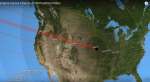 Eclipse Across America: Path Prediction Video
18.06.2017
Where will you be during the Eclipse across America? On August 21, the shadow of the Moon will cross the continental USA for the first time since 1979. The predicted path -- a certainty given modern astronomical knowledge -- is shown in the featured NASA video.
|
January February March April May June July August September October |
|||||||||||||||||||||||||||||||||||||||||||||||||