
|
You entered: dark
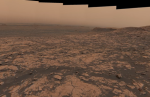 Curiosity Vista from Vera Rubin Ridge
10.09.2018
If you could stand on Mars -- what might you see? If you were NASA's Curiosity rover, just last month you would have seen the view from Vera Rubin Ridge, an intriguing rock-strewn perch on the side of Mount Sharp.
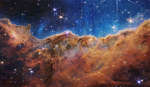 Carina Cliffs from the Webb Space Telescope
5.09.2022
Stars created these cliffs. Specifically, the destructive winds and energetic light from the stars in the open cluster NGC 3324 eroded away part of a mountain of dark interstellar dust in the northern part of the Carina Nebula.
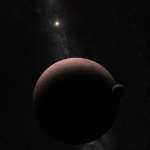 Moon over Makemake
31.12.2022
Makemake (sounds like MAH-kay MAH-kay), second brightest dwarf planet of the Kuiper belt, has a moon. Nicknamed MK2, Makemake's moon reflects sunlight with a charcoal-dark surface, about 1,300 times fainter than its parent body.
 Pandora s Cluster of Galaxies
9.06.2023
This deep field mosaicked image presents a stunning view of galaxy cluster Abell 2744 from the James Webb Space Telescope's NIRCam. Also dubbed Pandora's Cluster, Abell 2744 itself appears to be a ponderous merger of three different massive galaxy clusters some 3.5 billion light-years away toward the constellation Sculptor.
 M100: A Grand Design Spiral Galaxy
2.05.2024
Majestic on a truly cosmic scale, M100 is appropriately known as a grand design spiral galaxy. The large galaxy of over 100 billion stars has well-defined spiral arms, similar to our own Milky Way.
 APOD: 2025 January 26 Б The Many Tails of Comet G3 ATLAS
26.01.2025
Why does this comet have so many tails? C/2024 G3 (ATLAS) has developed several long and intricate tails visible from Earth's southern hemisphere over the past two weeks. Many observers reported seeing the impressive comet without any optical aid above the western horizon just after sunset.
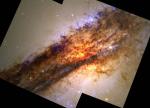 The Center of Centaurus A
1.10.2000
A fantastic jumble of young blue star clusters, gigantic glowing gas clouds, and imposing dark dust lanes surrounds the central region of the active galaxy Centaurus A. This mosaic of Hubble Space Telescope images taken in blue, green, and red light has been processed to present a natural color picture of this cosmic maelstrom.
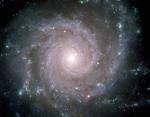 M74: The Perfect Spiral
4.10.2001
If not perfect, then this spiral galaxy is at least one of the most photogenic. An island universe of about 100 billion stars, 30 million light-years away toward the constellation Pisces, NGC 628 or M74 presents a gorgeous face-on view to earthbound astronomers.
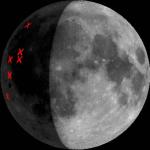 Moon Struck
8.12.2001
Craters produced by ancient impacts on the airless Moon have long been a familiar sight. But only since 1999 have observers seen elusive optical flashes on the lunar surface - likely explosions resulting from impacting meteoroids. These startling observations were made with modest telescopes and video equipment during the 1999 and 2001 Leonid meteor showers.
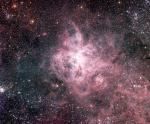 The Tarantula Zone
13.06.2002
The Tarantula Nebula is more than 1,000 light-years across - a giant emission nebula within our neighboring galaxy the Large Magellanic Cloud. Inside this cosmic arachnid lies a central young cluster of massive stars, cataloged as R136, whose intense radiation and strong winds have helped energize the nebular glow and shape the spidery filaments.
|
January February March April May June July August September |
|||||||||||||||||||||||||||||||||||||||||||||||||