
|
You entered: dark
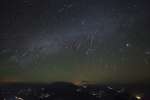 Geminid Meteor Shower over Dashanbao Wetlands
13.12.2013
The annual Geminid meteor shower is raining down on planet Earth this week. And despite the waxing gibbous moonlight, the reliable Geminids should be enjoyable tonight (night of December 13/14) near the shower's peak.
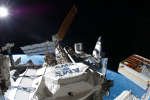 Space Station Detector Finds Unexplained Positron Excess
6.10.2014
Where did all these high energy positrons come from? The Alpha Magnetic Spectrometer (AMS-02) onboard the International Space Station (ISS) has been meticulously recording how often it is struck by both high energy electrons and positrons since 2011.
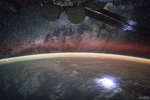 Space Station Vista: Planet and Galaxy
18.01.2017
If you could circle the Earth aboard the International Space Station, what might you see? Some amazing vistas, one of which was captured in this breathtaking picture in mid-2015. First, visible at the top, are parts of the space station itself including solar panels.
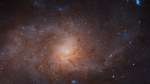 The Stars of the Triangulum Galaxy
23.02.2019
Like grains of sand on a cosmic beach, stars of the Triangulum Galaxy are resolved in this sharp mosaic from the Hubble Space Telescope's Advanced Camera for Surveys (ACS). The inner region of the galaxy spanning over 17,000 light-years is covered at extreme resolution, the second largest image ever released by Hubble.
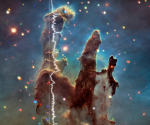 Sonified: Eagle Nebula Pillars
30.09.2020
Yes, but have you ever experienced the Eagle Nebula with your ears ? The famous nebula, M16, is best known for the feast it gives your eyes, highlighting bright young stars forming deep inside dark towering structures.
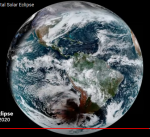 Earth During a Total Solar Eclipse
29.12.2020
What does the Earth look like during a total solar eclipse? It appears dark in the region where people see the eclipse, because that's where the shadow of the Moon falls. The shadow...
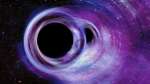 APOD: 2026 April Б Caught in the Web
3.04.2026
How can we see what is invisible? Black holes are not easy to see in the dark cosmic night, but astronomers can find them by analyzing their gravitational effects on matter, light and spacetime.
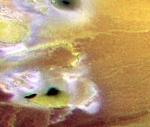 Calderas And Cliffs Near Io's South Pole
27.04.2000
Braving intense radiation belts, the Galileo spacecraft once again flew past the surface of Jupiter's moon Io (sounds like EYE-oh) on February 22. Combining high resolution black and white images from that flyby...
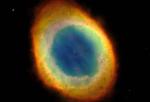 M57: The Ring Nebula
29.07.2001
Except for the rings of Saturn, the Ring Nebula (M57) is probably the most famous celestial band. This planetary nebula's simple, graceful appearance is thought to be due to perspective -- our view from planet Earth looking straight into what is actually a barrel-shaped cloud of gas shrugged off by a dying central star.
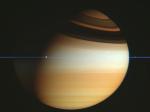 Cassini Spacecraft Crosses Saturns Ring Plane
4.05.2005
If this is Saturn, where are the rings? When Saturn's "appendages" disappeared in 1612, Galileo did not understand why. Later that century, it became understood that Saturn's unusual protrusions were rings and that when the Earth crosses the ring plane, the edge-on rings will appear to disappear.
|
January February March April May June July August September |
|||||||||||||||||||||||||||||||||||||||||||||||||