
|
You entered: dark
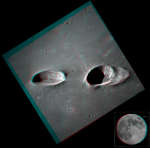 Messier Craters in Stereo
2.12.2017
Many bright nebulae and star clusters in planet Earth's sky are associated with the name of astronomer Charles Messier, from his famous 18th century catalog. His name is also given to these two large and remarkable craters on the Moon.
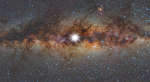 Solstice Sun and Milky Way
21.12.2017
Welcome to December's solstice, first day of winter in the north and summer for the southern hemisphere. Astronomical markers of the seasons, solstice and equinox dates are based on the Sun's place in its annual journey along the ecliptic, through planet Earth's sky.
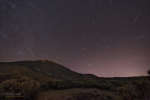 Quadrantids
9.01.2019
Named for a forgotten constellation, the Quadrantid Meteor Shower is an annual event for planet Earth's northern hemisphere skygazers It usually peaks briefly in the cold, early morning hours of January 4. The shower's radiant on the sky lies within the old, astronomically obsolete constellation Quadrans Muralis.
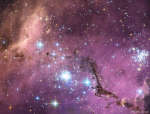 N11: Star Clouds of the LMC
29.04.2019
Massive stars, abrasive winds, mountains of dust, and energetic light sculpt one of the largest and most picturesque regions of star formation in the Local Group of Galaxies. Known as N11, the region...
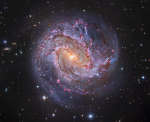 M83: The Thousand Ruby Galaxy
29.06.2019
Big, bright, and beautiful, spiral galaxy M83 lies a mere twelve million light-years away, near the southeastern tip of the very long constellation Hydra. Prominent spiral arms traced by dark dust lanes and blue star clusters lend this galaxy its popular name, The Southern Pinwheel.
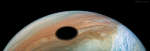 Io Eclipse Shadow on Jupiter from Juno
7.10.2019
What's that dark spot on Jupiter? It's the shadow of Jupiter's most volcanic moon Io. Since Jupiter shines predominantly by reflected sunlight, anything that blocks that light leaves a shadow. If you could somehow be in that shadow, you would see a total eclipse of the Sun by Io.
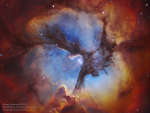 In the Center of the Trifid Nebula
1.11.2020
What's happening at the center of the Trifid Nebula? Three prominent dust lanes that give the Trifid its name all come together. Mountains of opaque dust appear near the bottom, while other dark filaments of dust are visible threaded throughout the nebula.
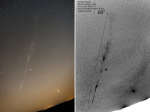 The Further Tail of Comet Leonard
30.12.2021
Comet Leonard, brightest comet of 2021, is at the lower left of these two panels captured on December 29 in dark Atacama desert skies. Heading for its perihelion on January 3 Comet Leonard's visible tail has grown.
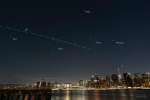 Eclipse in the City
12.11.2022
A darker Moon sets over Manhattan in this night skyscape. The 16 frame composite was assembled from consecutive exposures recorded during the November 8 total lunar eclipse. In the timelapse sequence stars leave short trails above the urban skyline, while the Moon remains immersed in Earth's shadow.
 APOD: 2023 May 8 Б The Spanish Dancer Spiral Galaxy
8.05.2023
If not perfect, then this spiral galaxy is at least one of the most photogenic. An island universe containing billions of stars and situated about 40 million light-years away toward the constellation of the Dolphinfish (Dorado), NGC 1566 presents a gorgeous face-on view.
|
January February March April May June July August September |
|||||||||||||||||||||||||||||||||||||||||||||||||