
|
You entered: dark
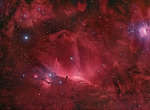 Wisps Surrounding the Horsehead Nebula
9.09.2012
The famous Horsehead Nebula in Orion is not alone. A deep exposure shows that the dark familiar shaped indentation, visible just below center, is part of a vast complex of absorbing dust and glowing gas.
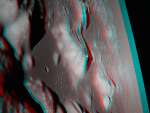 Apollo 17: A Stereo View from Lunar Orbit
13.12.2012
Get out your red/blue glasses and check out this awesome stereo view of another world. The scene was recorded by Apollo 17 mission commander Eugene Cernan on December 11, 1972, one orbit before descending to land on the Moon.
 Flying Past Neptunes Moon Triton
26.08.2014
What would it look like to fly past Triton, the largest moon of planet Neptune? Only one spacecraft has ever done this -- and now, for the first time, images of this dramatic encounter have been gathered into a movie. On 1989 August 25, the Voyager 2 spacecraft shot through the Neptune system with cameras blazing.
 Flyby Image of Saturns Sponge Moon Hyperion
3.06.2015
Why does this moon look like a sponge? To better investigate, NASA and ESA sent the Saturn-orbiting robotic spacecraft Cassini zooming past Saturn's moon Hyperion, once again, earlier this week. One of the images beamed back to Earth is featured above, raw and unprocessed.
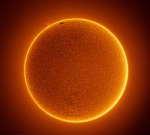 The Space Station Crosses a Spotless Sun
15.07.2019
That's no sunspot. It's the International Space Station (ISS) caught passing in front of the Sun. Sunspots, individually, have a dark central umbra, a lighter surrounding penumbra, and no solar panels. By contrast, the ISS is a complex and multi-spired mechanism, one of the largest and most sophisticated machines ever created by humanity.
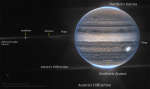 Jupiter from the Webb Space Telescope
30.08.2022
This new view of Jupiter is illuminating. High-resolution infrared images of Jupiter from the new James Webb Space Telescope (Webb) reveal, for example, previously unknown differences between high-floating bright clouds -- including the Great Red Spot -- and low-lying dark clouds.
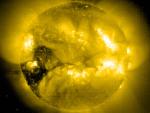 Coronal Holes on the Sun
18.03.2003
The ominous, dark shapes haunting the left side of the Sun are coronal holes -- low density regions extending above the surface where the solar magnetic field opens freely into interplanetary space. Studied extensively from...
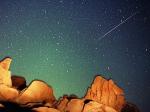 A Perseid Meteor
11.08.2004
The ongoing Perseid Meteor Shower should be at its strongest tonight and tomorrow night. Although meteors should be visible all night long, the best time to watch will be between 2:00 AM and dawn each night. In dark, moonless, predawn skies you may see dozens of meteors per hour.
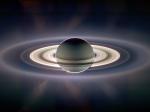 In the Shadow of Saturn
16.10.2006
In the shadow of Saturn, unexpected wonders appear. The robotic Cassini spacecraft now orbiting Saturn recently drifted in giant planet's shadow for about 12 hours and looked back toward the eclipsed Sun. Cassini saw a view unlike any other.
 Star Forming Region NGC 6357
20.12.2006
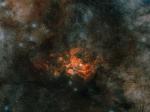
For reasons unknown, NGC 6357 is forming some of the most massive stars ever discovered. Near the more obvious Cat's Paw nebula, NGC 6357 houses the open star cluster Pismis 24, home to these tremendously bright and blue stars.
|
January February March April May June July August September |
|||||||||||||||||||||||||||||||||||||||||||||||||