
|
You entered: dark
 Galaxy Cluster Abell 370 and Beyond
12.09.2023
Some 4 billion light-years away, massive galaxy cluster Abell 370 is captured in this sharp Hubble Space Telescope snapshot. The cluster of galaxies only appears to be dominated by two giant elliptical galaxies and infested with faint arcs.
 APOD: 2025 February 19 Б HH 30: A Star System with Planets Now Forming
19.02.2025
How do stars and planets form? New clues have been found in the protoplanetary system Herbig-Haro 30 by the James Webb Space Telescope in concert with Hubble and the Earth-bound ALMA. The observations show, among other things, that large dust grains are more concentrated into a central disk where they can form planets.
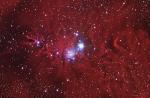 Fox Fur, the Unicorn, and a Christmas Tree
28.02.2003
Glowing hydrogen gas fills this gorgeously detailed sky view centered on the variable star S Mon in the faint but fanciful constellation Monoceros, the Unicorn. A star forming region (NGC 2264), the complex jumble...
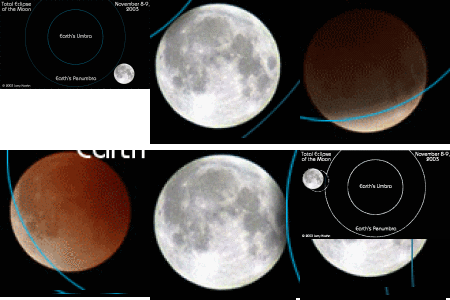 November s Lunar Eclipse
7.11.2003
The Moon slides through the Earth's shadow this Saturday night / Sunday morning (November 8/9) giving skygazers in the Americas, Europe, Africa, and western Asia a chance to enjoy a total lunar eclipse. As lunar eclipses go, this will be a brief one though, with the total phase lasting only about 25 minutes.
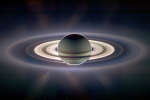 In the Shadow of Saturn
4.09.2011
In the shadow of Saturn, unexpected wonders appear. The robotic Cassini spacecraft now orbiting Saturn drifted in giant planet's shadow for about 12 hours in 2006 and looked back toward the eclipsed Sun. Cassini saw a view unlike any other.
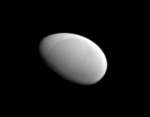 Methone: Smooth Egg Moon of Saturn
6.11.2012
Why is this moon shaped like a smooth egg? The robotic Cassini spacecraft completed the first flyby ever of Saturn's small moon Methone in May and discovered that the moon has no obvious craters.
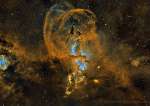 Star Forming Region NGC 3582
11.06.2013
What's happening in the NGC 3582 nebula? Bright stars and interesting molecules are forming. The complex nebula resides in the star forming region called RCW 57. Visible in this image are dense knots...
 ISS Double Transit
12.09.2015
Not once, but twice the International Space Station transits the Sun on consecutive orbits of planet Earth in this video frame composite. The scene was captured on August 22 from a single well-chosen location in Schmalenbeck, Germany where the ISS created intersecting shadow paths only around 7 kilometers wide.
 Detailed View of a Solar Eclipse Corona
13.08.2017
Only in the fleeting darkness of a total solar eclipse is the light of the solar corona easily visible. Normally overwhelmed by the bright solar disk, the expansive corona, the sun's outer atmosphere, is an alluring sight.
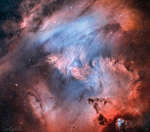 Wide Field: Fox Fur, Unicorn, and Christmas Tree
10.03.2020
What do the following things have in common: a cone, the fur of a fox, and a Christmas tree? Answer: they all occur in the constellation of the unicorn (Monoceros). Pictured as a star...
|
January February March April May June July August September |
|||||||||||||||||||||||||||||||||||||||||||||||||