
|
You entered: dark
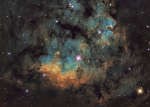 NGC 7822 in Cepheus
19.01.2022
Hot, young stars and cosmic pillars of gas and dust seem to crowd into NGC 7822. At the edge of a giant molecular cloud toward the northern constellation Cepheus, the glowing star forming region lies about 3,000 light-years away. Within the nebula, bright edges and dark shapes stand out in this colorful telescopic skyscape.
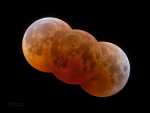 Total Lunar Eclipse
9.11.2022
The beginning, middle, and end of a journey through planet Earth's colorful umbral shadow is captured in this timelapse composite image of a total lunar eclipse. Taken on November 8 from Kitt Peak...
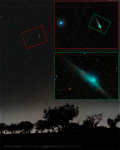 APOD: 2023 January 31 Б A Triple View of Comet ZTF
30.01.2023
Comet ZTF has a distinctive shape. The now bright comet visiting the inner Solar System has been showing not only a common dust tail, ion tail, and green gas coma, but also an uncommonly distinctive antitail.
 APOD: 2025 January 27 Б Pleiades over Half Dome
26.01.2025
Stars come in bunches. The most famous bunch of stars on the sky is the Pleiades, a bright cluster that can be easily seen with the unaided eye. The Pleiades lies only about 450 light years away, formed about 100 million years ago, and will likely last about another 250 million years.
 APOD: 2025 September 1 Б Callisto: Dirty Battered Iceball
31.08.2025
Its surface is the most densely cratered in the Solar System -- but what's inside? Jupiter's moon Callisto is a battered ball of dirty ice that is larger than the planet Mercury.
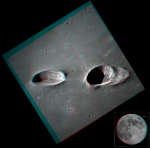 APOD: 2026 May 9 Б Messier Craters in Stereo
8.05.2026
Many bright nebulae and star clusters in planet Earth's sky are associated with the name of astronomer Charles Messier from his famous 18th century catalog. His name is also given to these two large and remarkable craters on the Moon.
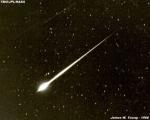 A Leonid Fireball From 1966
12.11.1998
This bright fireball meteor was photographed from Table Mountain Observatory during the peak of the annual Leonid meteor shower on November 17, 1966. That was a good year for Leonid meteor watchers - a meteor "storm" was produced as the Earth swept through a dense swarm of dusty debris from the tail of comet Tempel-Tuttle.
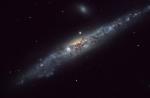 NGC 4631: The Whale Galaxy
28.03.2002
NGC 4631 is a big beautiful spiral galaxy seen edge-on only 25 million light-years away towards the small northern constellation Canes Venatici. This galaxy's slightly distorted wedge shape suggests to some a cosmic herring and to others the popular moniker of The Whale Galaxy.
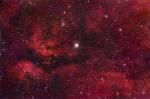 Central Cygnus
3.01.2007
Supergiant star Gamma Cygni lies at the center of the Northern Cross, famous asterism in the constellation Cygnus the Swan. Known by the proper name Sadr, the bright star also lies at the center...
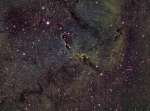 The Elephant s Trunk in IC 1396
25.12.2008
(xxxedit and linkxxx) Like an illustration in a galactic Just So Story, the Elephant's Trunk Nebula winds through the emission nebula and young star cluster complex IC 1396, in the high and far off constellation of Cepheus. Of course, this cosmic elephant's trunk is over 20 light-years long.
|
January February March April May June July August September |
|||||||||||||||||||||||||||||||||||||||||||||||||