
|
You entered: dark
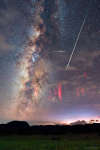 Perseid Meteor, Red Sprites, and Nova RS Oph
16.08.2021
This was an unusual sky. It wasn't unusual because of the central band the Milky Way Galaxy, visible along the image left. Most dark skies show part of the Milky Way. It wasn't unusual because of the bright meteor visible on the upper right.
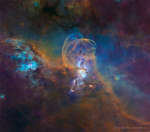 Star Forming Region NGC 3582 without Stars
20.09.2022
What's happening in the Statue of Liberty nebula? Bright stars and interesting molecules are forming and being liberated. The complex nebula resides in the star forming region called RCW 57, and besides the iconic monument, to some looks like a flying superhero or a weeping angel.
 APOD: 2023 November 7 Б A Martian Dust Devil Spins By
7.11.2023
It moved across the surface of Mars -- what was it? A dust devil. Such spinning columns of rising air are heated by the warm surface and are also common in warm and dry areas on planet Earth.
 APOD: 2024 September 9 Б Mars: Moon, Craters, and Volcanos
9.09.2024
If you could fly over Mars, what might you see? The featured image shows exactly this in the form of a Mars Express vista captured over a particularly interesting region on Mars in July. The picture's most famous feature is Olympus Mons, the largest volcano in the Solar System, visible on the upper right.
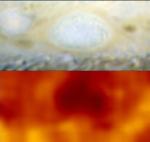 Jupiter: When Storms Collide
22.10.1998
Sometime in February, two of three long-lived Jovian storm systems known as "white ovals" apparently collided and merged -- forming what is now likely the second largest storm in the Solar System, after the famous Great Red Spot.
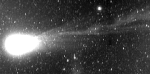 The Ion Tail of Comet Hyakutake
19.03.1996
This picture of Comet Hyakutake was taken on March 14, 1996. Structure in the ion tale of Comet Hyakutake is now clearly visible. An ion tale forms as a comet nears the Sun. Sunlight causes gas and dust to boil off the comet's solid nucleus.
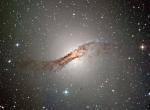 Dusty Galaxy Centaurus A
6.08.2003
Why is peculiar galaxy Centaurus A so dusty? Dramatic dust lanes that run across the galaxy's center mark Cen A. These dust lanes are so thick they almost completely obscure the galaxy's center in visible light.
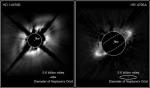 Possible Planets And Infrared Dust
20.01.1999
These near-infrared Hubble images of dust surrounding young stars offer the latest tantalizing evidence for planets beyond our Solar System. At left, the dark gap seen in the dust disk is reminiscent of a similar large gap in Saturn's rings believed to be sculpted by orbiting moons.
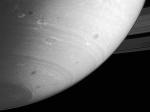 Storm Alley on Saturn
2.11.2004
What causes storms on Saturn? To help find out, scientists commanded the robot Cassini spacecraft now orbiting Saturn to inspect a circulating band of clouds nicknamed "Storm Alley." This westwardly moving cloud ring...
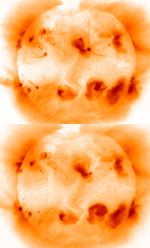 X Ray Triple Jet
31.07.1999
Recorded on July 7, 1998, this animation using X-ray images of the Sun shows an amazing event - three nearly simultaneous jets connected with solar active regions. The two frames were taken several hours apart by the Soft X-ray Telescope on board the orbiting Yohkoh observatory.
|
January February March April May June July August September |
|||||||||||||||||||||||||||||||||||||||||||||||||