
|
You entered: dark
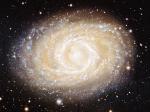 Barred Spiral Galaxy M95
14.03.2007
Why do some spiral galaxies have a ring around the center? First and foremost, M95 is one of the closer examples of a big and beautiful barred spiral galaxy. Visible in the above recent...
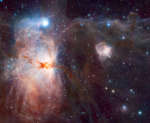 The Flame Nebula in Infrared
12.01.2010
What lights up the Flame Nebula? Fifteen hundred light years away towards the constellation of Orion lies a nebula which, from its glow and dark dust lanes, appears, on the left, like a billowing fire. But fire, the rapid acquisition of oxygen, is not what makes this Flame glow.
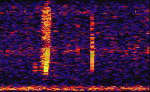 The Bloop: A Mysterious Sound from the Deep Ocean
27.04.2010
What created this strange sound in Earth's Pacific Ocean? Pictured above is a visual representation of a loud and unusual sound, dubbed a Bloop, captured by deep sea microphones in 1997. In the above graph, time is shown on the horizontal axis, deep pitch is shown on the vertical axis, and brightness designates loudness.
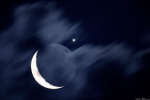 Moon Meets Jupiter
10.07.2016
What's that next to the Moon? Jupiter -- and its four largest moons. Skygazers around planet Earth enjoyed the close encounter of planets and Moon in 2012 July 15's predawn skies. And while...
 NGC 891 vs Abell 347
12.11.2016
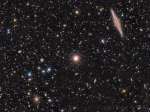
Galaxies abound in this well-chosen field of view that spans about 1 degree on the sky toward the northern constellation Andromeda. At top right is large spiral galaxy NGC 891, 100 thousand light-years across and seen almost exactly edge-on.
 Dust, Gas, and Stars in the Orion Nebula
8.03.2017
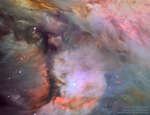
The Great Nebula in Orion, an immense, nearby starbirth region, is probably the most famous of all astronomical nebulas. Here, filaments of dark dust and glowing gas surround hot young stars at the edge of an immense interstellar molecular cloud only 1500 light-years away.
 Shackleton from ShadowCam
5.05.2023
Shackleton crater lies at the lunar south pole. Peaks along the 21 kilometer diameter are in sunlight, but Shackleton's floor is in dark permanent shadow. Still, this image of the shadowed rim wall...
 Double Asteroid 90 Antiope
1.11.2000
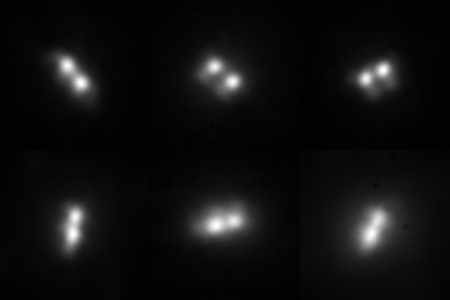
This eight-frame animation is based on the first ever images of a double asteroid! Formerly thought to be a single enormous chunk of rock, asteroid 90 Antiope resides in the solar system's main asteroid belt between Mars and Jupiter.
 2dF Sees Waves of Galaxies
4.09.2001
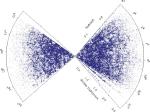
How are galaxies distributed in the universe? This question is of more than aesthetic interest because the answer likely holds clues to composition of the universe itself. The above map shows the distribution...
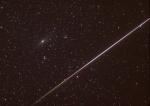 Island Universe, Cosmic Sand
23.08.2002
On August 13, while counting Perseid meteors under dark, early morning Arizona skies, Rick Scott set out to photograph their fleeting but fiery trails. The equipment he used included a telephoto lens and fast color film. After 21 pictures he'd caught only two meteors, but luckily this was one of them.
|
January February March April May June July August September |
|||||||||||||||||||||||||||||||||||||||||||||||||