
|
You entered: dark
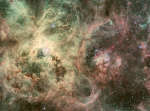 Tentacles of the Tarantula Nebula
18.05.2010
The largest, most violent star forming region known in the whole Local Group of galaxies lies in our neighboring galaxy the Large Magellanic Cloud (LMC). Were the Tarantula Nebula at the distance of the Orion Nebula -- a local star forming region -- it would take up fully half the sky.
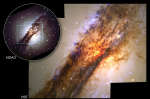 The Center of Centaurus A
7.11.2010
A fantastic jumble of young blue star clusters, gigantic glowing gas clouds, and imposing dark dust lanes surrounds the central region of the active galaxy Centaurus A. This mosaic of Hubble Space Telescope images taken in blue, green, and red light has been processed to present a natural color picture of this cosmic maelstrom.
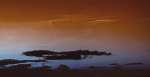 Noctilucent Clouds and Aurora Over Scotland
19.08.2013
Why would the sky still glow after sunset? Besides stars and the band of our Milky Way galaxy, the sky might glow because it contains either noctilucent clouds or aurora. Rare individually, both are visible in the above time lapse movie taken over Caithness, Scotland, UK taken during a single night earlier this month.
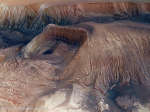 Collapse in Hebes Chasma on Mars
12.08.2014
What's happened in Hebes Chasma on Mars? Hebes Chasma is a depression just north of the enormous Valles Marineris canyon. Since the depression is unconnected to other surface features, it is unclear where the internal material went.
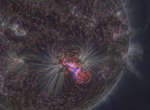 Solar Flare from a Sharper Sun
21.11.2014
Solar active region AR2192 was the largest recorded sunspot group of the last 24 years. Before rotating off the Earth-facing side of the Sun at the end of October, it produced a whopping six energetic X-class flares.
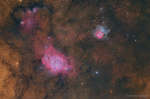 A Sagittarius Triplet
10.08.2015
These three bright nebulae are often featured in telescopic tours of the constellation Sagittarius and the crowded starfields of the central Milky Way. In fact, 18th century cosmic tourist Charles Messier cataloged two of them; M8, the large nebula left of center, and colorful M20 on the right.
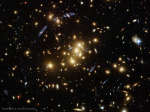 Giant Cluster Bends Breaks Images
23.08.2015
What are those strange blue objects? Many of the brightest blue images are of a single, unusual, beaded, blue, ring-like galaxy which just happens to line-up behind a giant cluster of galaxies. Cluster galaxies here typically appear yellow and -- together with the cluster's dark matter -- act as a gravitational lens.
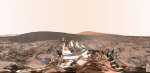 NASAs Curiosity Rover at Namib Dune (360 View)
29.03.2016
Point or tilt to see a spectacular view of Mars visible to the Curiosity rover last December. In the foreground, part of Curiosity itself is visible, including its dusty sundial. Starting about seven meters...
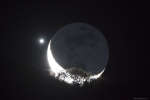 Moon and Venus Appulse over a Tree
6.02.2019
What's that bright spot near the Moon? Venus. About a week ago, Earth's Moon appeared unusually close to the distant planet Venus, an angular coincidence known as an appulse. Similar to a conjunction, which is a coordinate term, an appulse refers more generally to when two celestial objects appear close together.
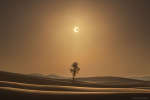 A Desert Eclipse
13.01.2020
A good place to see a ring-of-fire eclipse, it seemed, would be from a desert. In a desert, there should be relatively few obscuring clouds and trees. Therefore late last December a group...
|
January February March April May June July August September |
|||||||||||||||||||||||||||||||||||||||||||||||||