
|
You entered: Observatory
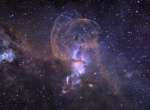 The NGC 3576 Nebula
26.03.2008
An intriguing and beautiful nebula, NGC 3576 drifts through the Sagittarius arm of our spiral Milky Way Galaxy. Within the region, episodes of star formation are thought to contribute to the complex and suggestive shapes. Powerful winds from the nebula's embedded, young, massive stars shape the looping filaments.
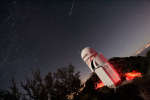 Geminids over Kit Peak
16.12.2010
Two large telescope domes stand in the foreground of this night sky view from Kitt Peak National Observatory, near Tucson, Arizona, USA. The dramatic scene was recorded early Tuesday morning, near the peak of December's Geminid Meteor Shower.
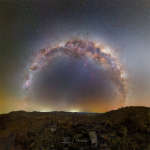 Stargate Milky Way
17.08.2022
There is a huge gate of stars in the sky, and you pass through it twice a day. The stargate is actually our Milky Way Galaxy, and it is the spin of the Earth that appears to propel you through it.
 A Message From Earth
13.03.2005
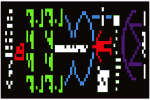
What are these Earthlings trying to tell us? The above message was broadcast from Earth towards the globular star cluster M13 in 1974. During the dedication of the Arecibo Observatory - still the largest radio telescope in the world - a string of 1's and 0's representing the above diagram was sent.
 A Message From Earth
19.02.2012
What are these Earthlings trying to tell us? The above message was broadcast from Earth towards the globular star cluster M13 in 1974. During the dedication of the Arecibo Observatory - still the largest single radio telescope in the world - a string of 1's and 0's representing the above diagram was sent.
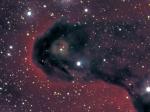 VDB 142 in Cepheus
11.10.2001
A gorgeous collection of dust and gas nebulae in the Northern Milky Way graces the high and far off constellation of Cepheus. With colors based on astronomical filters, this close up of the region highlights stars embedded in curiously shaped cosmic clouds.
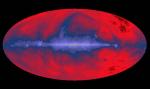 The Radio Sky: Tuned to 408MHz
20.10.2001
Tune your radio telescope to 408MHz (408 million cycles per second) and check out the Radio Sky! You should find that frequency on your dial somewhere between US broadcast television channels 13 and 14.
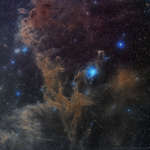 Chamaeleon Dark Nebulas
17.01.2022
Sometimes the dark dust of interstellar space has an angular elegance. Such is the case toward the far-south constellation of Chamaeleon. Normally too faint to see, dark dust is best known for blocking visible light from stars and galaxies behind it.
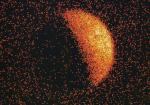 X Ray Moon
14.09.2002
This x-ray image of the Moon was made by the orbiting ROSAT (Röntgensatellit) Observatory in 1990. In this digital picture, pixel brightness corresponds to x-ray intensity. Consider the image in three parts: the bright hemisphere of the x-ray moon, the darker half of the moon, and the x-ray sky background.
 Rainbow at Sunset
7.08.2010
Where is the Sun when you see a rainbow? Behind you, of course. But you can see both a rainbow and the Sun (far right) side by side in this graceful panorama recorded on July 28.
|
January February March April May June July August September October |
|||||||||||||||||||||||||||||||||||||||||||||||||