
|
You entered: X-ray
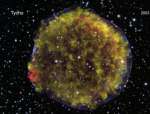 Tychos Supernova Remnant Expands
1.06.2016
What star created this huge expanding puffball? Featured here is the first expansion movie ever created for Tycho's supernova remnant, the result of a stellar explosion first recorded over 400 years ago by the famous astronomer Tycho Brahe.
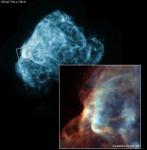 Supernova Remnant and Shock Wave
17.02.2006
A massive star ends life as a supernova, blasting its outer layers back to interstellar space. The spectacular death explosion is initiated by the collapse of what has become an impossibly dense stellar core. Pictured is the expanding supernova remnant Puppis A - one of the brightest sources in the x-ray sky.
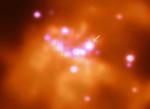 M82 s Middle Mass Black Hole
14.09.2000
Black holes are probably the most bizarre creatures in the modern astronomical zoo. And after years of pondering black holes as either stellar mass objects seen in binary star systems or enormous supermassive black holes at the centers of galaxies, astronomers now have strong evidence
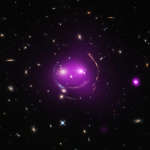 Gravity s Grin
26.10.2019
Albert Einstein's general theory of relativity, published over 100 years ago, predicted the phenomenon of gravitational lensing. And that's what gives these distant galaxies such a whimsical appearance, seen through the looking glass of X-ray and optical image data from the Chandra and Hubble space telescopes.
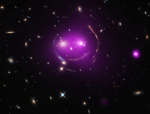 Gravity s Grin
5.08.2017
Albert Einstein's general theory of relativity, published over 100 years ago, predicted the phenomenon of gravitational lensing. And that's what gives these distant galaxies such a whimsical appearance, seen through the looking glass of X-ray and optical image data from the Chandra and Hubble space telescopes.
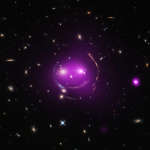 Gravity s Grin
11.05.2022
Albert Einstein's general theory of relativity, published over 100 years ago, predicted the phenomenon of gravitational lensing. And that's what gives these distant galaxies such a whimsical appearance, seen through the looking glass of X-ray and optical image data from the Chandra and Hubble space telescopes.
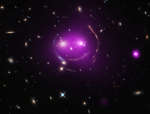 Gravity s Grin
27.11.2015
Albert Einstein's general theory of relativity, published 100 years ago this month, predicted the phenomenon of gravitational lensing. And that's what gives these distant galaxies such a whimsical appearance, seen through the looking glass of X-ray and optical image data from the Chandra and Hubble space telescopes.
 Light from Cygnus A
23.01.2015
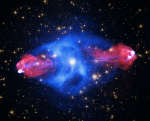
Celebrating astronomy in this International Year of Light, the detailed image reveals spectacular active galaxy Cygnus A in light across the electromagnetic spectrum. Incorporating X-ray data ( blue) from the orbiting Chandra Observatory, Cygnus A is seen to be a prodigious source of high energy x-rays.
 Binary Black Hole in 3C 75
12.04.2006
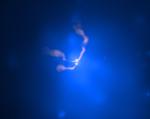
The two bright sources at the center of this composite x-ray (blue)/ radio (pink) image are co-orbiting supermassive black holes powering the giant radio source 3C 75. Surrounded by multimillion degree x-ray emitting gas, and blasting out jets of relativistic particles the supermassive black holes are separated by 25,000 light-years.
 21st Century M101
13.07.2012
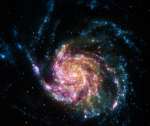
One of the last entries in Charles Messier's famous catalog, big, beautiful spiral galaxy M101 is definitely not one of the least. About 170,000 light-years across, this galaxy is enormous, almost twice the size of our own Milky Way Galaxy.
|
January February March April May June July August September October |
|||||||||||||||||||||||||||||||||||||||||||||||||