
|
You entered: X-ray
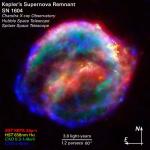 Kepler s SNR from Chandra, Hubble, Spitzer
8.10.2004
Light from the stellar explosion that created this energized cosmic cloud was first seen on planet Earth in October 1604, a mere four hundred years ago. The supernova produced a bright new star in early 17th century skies within the constellation Ophiucus.
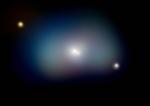 NGC 1700: Elliptical Galaxy and Rotating Disk
16.01.2003
In spiral galaxies, majestic winding arms of young stars and interstellar gas and dust rotate in a disk around a bulging galactic nucleus. Elliptical galaxies seem to be simpler, randomly swarming with old stars and lacking gas and dust.
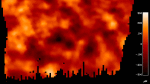 A Year of Resolving Backgrounds
30.12.2000
No matter which direction you look, no matter what type of light you see, the sky glows - but why? The sources of many of these background radiations have remained long-standing puzzles, but this millennial year brought some partial resolutions.
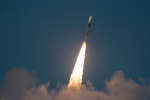 Hitomi Launches
18.02.2016
On February 17 at 5:45pm JST this H-IIA rocket blasted skyward from JAXA's Tanegashima Space Center located off the southern coast of Japan, planet Earth. Onboard was the ASTRO-H X-ray astronomy satellite, now in orbit.
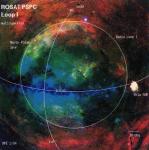 Loop I in the Northern Sky
3.05.1999
One of the largest coherent structures on the sky is known simply as Loop I and can best be seen in radio and X-ray maps. Spanning over 100 degrees, part of Loop I appears so prominent in northern sky maps that it is known as the North Polar Spur (NPS).
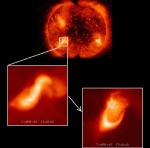 Sigmoids Predict Solar Eruptions
16.03.1999
On the Sun, S marks the spot. Solar explosions have been discovered to explode preferentially from regions marked with this letter. The surface of the quiet Sun is a maze of hot gas and flowing magnetic fields. When two regions of high magnetic field strength approach each other, they typically pass uneventfully.
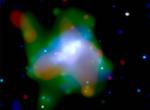 NGC 1569: Heavy Elements from a Small Galaxy
25.07.2002
For astronomers, elements other than hydrogen and helium are sometimes considered to be simply "heavy elements". It's understandable really, because even lumped all together heavy elements make up an exceedingly small fraction of the Universe. Still, heavy elements can profoundly influence galaxy and star formation ... not to mention the formation of planets and people.
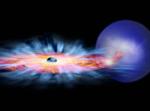 Wind from a Black Hole
1.07.2006
Binary star system GRO J1655-40 consists of a relatively normal star about twice as massive as the Sun co-orbiting with a black hole of about seven solar masses. This striking artist's vision of the exotic binary system helps visualize matter drawn from the normal star by gravity and swirling toward the black hole.
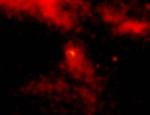 Pulsar Wind in the Vela Nebula
19.07.2001
The Vela pulsar was born 10,000 years ago at the center of a supernova -- an exploding star. In this Chandra Observatory x-ray image, the pulsar still produces a glowing nebula at the heart of the expanding cloud of stellar debris.
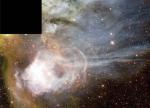 N44C: A Nebular Mystery
14.05.2002
Why is N44C glowing so strangely? The star that appears to powers the nebula, although young and bright, does not seem hot enough to create some of the colors observed. A search for a hidden hotter star in X-rays has come up empty.
|
January February March April May June July August September October |
|||||||||||||||||||||||||||||||||||||||||||||||||