
|
You entered: filament
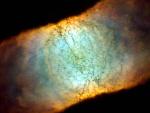 IC 4406: A Seemingly Square Nebula
18.06.2002
How can a round star make a square nebula? This conundrum comes to light when studying planetary nebulae like IC 4406. Evidence indicates that IC 4406 is likely a hollow cylinder, with its square appearance the result of our vantage point in viewing the cylinder from the side.
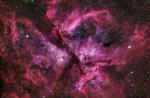 The Great Carina Nebula
27.10.2007
A jewel of the southern sky, the Great Carina Nebula, aka NGC 3372, spans over 300 light-years, one of our galaxy's largest star forming regions. Like the smaller, more northerly Orion Nebula...
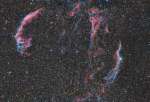 Wisps of the Veil Nebula
26.11.2012
Wisps like this are all that remain visible of a Milky Way star. About 9,000 years ago that star exploded in a supernova leaving the Veil Nebula, also known as the Cygnus Loop.
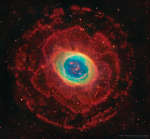 Rings Around the Ring Nebula
18.08.2021
The Ring Nebula (M57), is more complicated than it appears through a small telescope. The easily visible central ring is about one light-year across, but this remarkably deep exposure - a collaborative effort combining data from three different large telescopes - explores the looping filaments of glowing gas extending much farther from the nebula's central star.
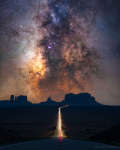 Road to the Galactic Center
25.10.2021
Does the road to our galaxy's center go through Monument Valley? It doesn't have to, but if your road does -- take a picture. In this case, the road is US Route 163 and iconic buttes on the Navajo National Reservation populate the horizon.
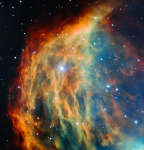 The Medusa Nebula
12.06.2015
Braided, serpentine filaments of glowing gas suggest this nebula's popular name, The Medusa Nebula. Also known as Abell 21, this Medusa is an old planetary nebula some 1,500 light-years away along the southern border of the constellation Gemini. Like its mythological namesake, the nebula is associated with a dramatic transformation.
 The Great Carina Nebula
19.04.2024
A jewel of the southern sky, the Great Carina Nebula is more modestly known as NGC 3372. One of our Galaxy's largest star forming regions, it spans over 300 light-years. Like the smaller, more northerly Great Orion Nebula, the Carina Nebula is easily visible to the unaided eye.
 APOD: 2024 April 28 Б Rings Around the Ring Nebula
28.04.2024
The Ring Nebula (M57) is more complicated than it appears through a small telescope. The easily visible central ring is about one light-year across, but this remarkably deep exposure - a collaborative effort combining data from three different large telescopes - explores the looping filaments of glowing gas extending much farther from the nebula's central star.
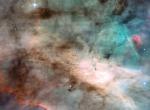 In the Center of the Omega Nebula
8.02.2004
In the depths of the dark clouds of dust and molecular gas known as the Omega Nebula, stars continue to form. The above image from the Hubble Space Telescope's Advanced Camera for Surveys shows exquisite detail in the famous star-forming region.
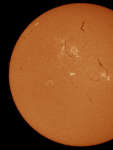 A Transit of Mercury
12.05.2016
On May 9, the diminutive disk of Mercury spent about seven and a half hours crossing in front of the Sun as viewed from the general vicinity of Earth. It was the second of 14 transits of the Solar System's innermost planet in the 21st century.
|
January February March April May June July August September October |
|||||||||||||||||||||||||||||||||||||||||||||||||