
|
You entered: filament
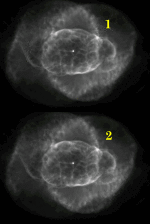 The Incredible Expanding Cats Eye
16.09.1999
Watch closely. As this animation blinks between two Hubble Space Telescope images of NGC 6543 - the first from 1994 and the second from 1997 - the intricate filaments of this nebula are seen to shift. The shift is due to the actual expansion of this gaseous shroud shed by a dying star!
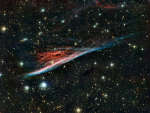 NGC 2736: The Pencil Nebula
24.09.2012
This shock wave plows through space at over 500,000 kilometers per hour. Moving toward to bottom of this beautifully detailed color composite, the thin, braided filaments are actually long ripples in a sheet of glowing gas seen almost edge on. Cataloged as NGC 2736, its narrow appearance suggests its popular name, the Pencil Nebula.
 APOD: 2025 June 17 Б Rosette Nebula Deep Field
17.06.2025
Can you find the Rosette Nebula? The red flowery-looking nebula just above the image center may seem a good choice, but that's not it. The famous Rosette Nebula is really located on the lower right, here colored blue and white, and connected to the other nebulas by gold-colored filaments.
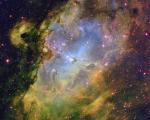 Inside the Eagle Nebula
24.10.2004
From afar, the whole thing looks like an Eagle. A closer look at the Eagle Nebula, however, shows the bright region is actually a window into the center of a larger dark shell of dust. Through this window, a brightly-lit workshop appears where a whole open cluster of stars is being formed.
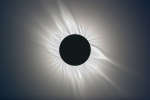 The Big Corona
26.07.2009
Most photographs don't adequately portray the magnificence of the Sun's corona. Seeing the corona first-hand during a total solar eclipse is best. The human eye can adapt to see features and extent that photographic film usually cannot. Welcome, however, to the digital age.
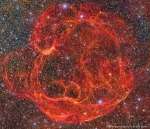 Simeis 147: Supernova Remnant
25.04.2016
It's easy to get lost following the intricate strands of the Spaghetti Nebula. A supernova remnant cataloged as Simeis 147 and Sh2-240, the glowing gas filaments cover nearly 3 degrees -- 6 full moons -- on the sky. That's about 150 light-years at the stellar debris cloud's estimated distance of 3,000 light-years.
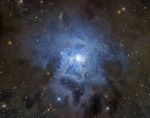 NGC 7023: The Iris Nebula
3.09.2021
These cosmic clouds have blossomed 1,300 light-years away, in the fertile starfields of the constellation Cepheus. Called the Iris Nebula, NGC 7023 is not the only nebula to evoke the imagery of flowers.
 APOD: 2023 August 14 Б The Ring Nebula from Webb
14.08.2023
The Ring Nebula (M57), is more complicated than it appears through a small telescope. The easily visible central ring is about one light-year across, but this remarkable exposure by the James Webb Space Telescope explores this popular nebula with a deep exposure in infrared light.
 NGC 7023: The Iris Nebula
2.09.2023
These cosmic clouds have blossomed 1,300 light-years away in the fertile starfields of the constellation Cepheus. Called the Iris Nebula, NGC 7023 is not the only nebula to evoke the imagery of flowers.
 NGC 7023: The Iris Nebula
25.07.2024
These cosmic clouds have blossomed 1,300 light-years away in the fertile starfields of the constellation Cepheus. Called the Iris Nebula, NGC 7023 is not the only nebula to evoke the imagery of flowers.
|
January February March April May June July August September October |
|||||||||||||||||||||||||||||||||||||||||||||||||