
|
You entered: filament
 APOD: 2023 May 3 Б Centaurus A: A Peculiar Island of Stars
3.05.2023
Galaxies are fascinating. In galaxies, gravity alone holds together massive collections of stars, dust, interstellar gas, stellar remnants and dark matter. Pictured is NGC 5128, better known as Centaurus A. Cen A is the fifth brightest galaxy on the sky and is located at a distance of about 12 million light years from Earth.
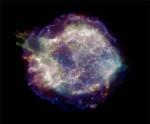 Cas A Supernova Remnant in X Rays
24.08.2002
The complex shell of a star seen to explode 300 years ago is helping astronomers to understand how that star exploded. This Chandra Observatory image of supernova remnant Cassiopeia A (Cas A) shows unprecedented detail in three x-ray colors.
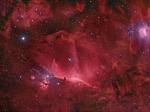 Wisps Surrounding the Horsehead Nebula
21.02.2006
The famous Horsehead Nebula in Orion is not alone. A deep exposure shows that the dark familiar shaped indentation, visible just below center, is part of a vast complex of absorbing dust and glowing gas.
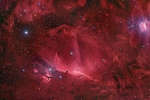 Wisps Surrounding the Horsehead Nebula
6.04.2008
The famous Horsehead Nebula in Orion is not alone. A deep exposure shows that the dark familiar shaped indentation, visible just below center, is part of a vast complex of absorbing dust and glowing gas.
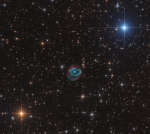 Planetary Nebula Abell 78
16.10.2020
Planetary nebula Abell 78 stands out in this colorful telescopic skyscape. In fact the colors of the spiky Milky Way stars depend on their surface temperatures, both cooler (yellowish) and hotter (bluish) than the Sun.
 APOD: 2024 September 29 Б Seven Dusty Sisters
29.09.2024
Is this really the famous Pleiades star cluster? Known for its iconic blue stars, the Pleiades is shown here in infrared light where the surrounding dust outshines the stars. Here, three infrared colors have been mapped into visual colors (R=24, G=12, B=4.6 microns).
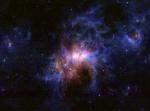 Dusty Environs of Eta Carinae
15.10.2005
Eta Car is a massive star, but it's not as bright as it used to be. Now only easily visible in binoculars or a small telescope, Eta Carinae has a history of spectacular flaring and fading behavior.
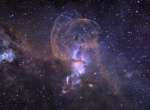 The NGC 3576 Nebula
26.03.2008
An intriguing and beautiful nebula, NGC 3576 drifts through the Sagittarius arm of our spiral Milky Way Galaxy. Within the region, episodes of star formation are thought to contribute to the complex and suggestive shapes. Powerful winds from the nebula's embedded, young, massive stars shape the looping filaments.
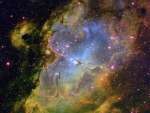 Inside the Eagle Nebula
8.02.2009
From afar, the whole thing looks like an Eagle. A closer look at the Eagle Nebula, however, shows the bright region is actually a window into the center of a larger dark shell of dust. Through this window, a brightly-lit workshop appears where a whole open cluster of stars is being formed.
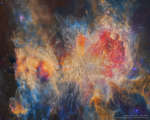 The Orion Nebula in Infrared from WISE
2.01.2019
The Great Nebula in Orion is an intriguing place. Visible to the unaided eye, it appears as a small fuzzy patch in the constellation of Orion. But this image, an illusory-color four-panel mosaic taken...
|
January February March April May June July August September October |
|||||||||||||||||||||||||||||||||||||||||||||||||