
|
You entered: filament
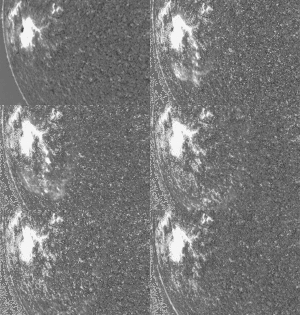 A Large Tsunami Shock Wave on the Sun
25.09.2011
Tsunamis this large don't happen on Earth. During 2006, a large solar flare from an Earth-sized sunspot produced a tsunami-type shock wave that was spectacular even for the Sun. Pictured above, the tsunami...
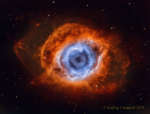 The Helix Nebula in Hydrogen and Oxygen
12.02.2019
Is the Helix Nebula looking at you? No, not in any biological sense, but it does look quite like an eye. The Helix Nebula is so named because it also appears that you are looking down the axis of a helix.
 Dusty Environs of Eta Carinae
10.10.2002
Eta Car is a massive star, but it's not as bright as it used to be. Now only easily visible in binoculars or a small telescope, Eta Carinae has a history of spectacular flaring and fading behavior.
 Sivan 2 to M31
2.03.2017
From within the boundaries of the constellation Cassiopeia (left) to Andromeda (right), this telescopic mosaic spans over 10 degrees in planet Earth's skies. The celestial scene is constructed of panels that are part of a high-resolution astronomical survey of the Milky Way in hydrogen-alpha light.
 APOD: 2024 December 17 Б Near to the Heart Nebula
16.12.2024
What excites the Heart Nebula? First, the large emission nebula on the upper left, catalogued as IC 1805, looks somewhat like a human heart. The nebula glows brightly in red light emitted by its most prominent element, hydrogen, but this long-exposure image was also blended with light emitted by sulfur (yellow) and oxygen (blue).
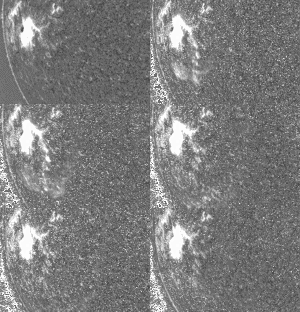 A Large Tsunami Shock Wave on the Sun
12.12.2006
Tsunami's this large don't happen on Earth. One week ago, a large solar flare from an Earth-sized sunspot produced a tsunami-type shock wave that was spectacular even for the Sun. Pictured above...
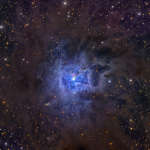 NGC 7023: The Iris Nebula
2.08.2014
These clouds of interstellar dust and gas have blossomed 1,300 light-years away in the fertile star fields of the constellation Cepheus. Sometimes called the Iris Nebula, NGC 7023 is not the only nebula in the sky to evoke the imagery of flowers, though.
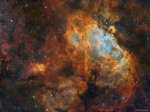 M16: In and Around the Eagle Nebula
14.10.2018
From afar, the whole thing looks like an Eagle. A closer look at the Eagle Nebula, however, shows the bright region is actually a window into the center of a larger dark shell of dust. Through this window, a brightly-lit workshop appears where a whole open cluster of stars is being formed.
 Wisps Surrounding the Horsehead Nebula
2.04.2019
The famous Horsehead Nebula in Orion is not alone. A deep exposure shows that the dark familiar shaped indentation, visible just below center, is part of a vast complex of absorbing dust and glowing gas.
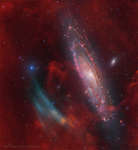 APOD: 2023 January 17 Б Unexpected Clouds Toward the Andromeda Galaxy
16.01.2023
Why are there oxygen-emitting arcs near the direction of the Andromeda galaxy? No one is sure. The gas arcs, shown in blue, were discovered and first confirmed by amateur astronomers just last year.
|
January February March April May June July August September October |
|||||||||||||||||||||||||||||||||||||||||||||||||