
|
You entered: filament
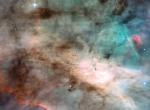 In the Center of the Omega Nebula
1.05.2002
In the depths of the dark clouds of dust and molecular gas known as the Omega Nebula, stars continue to form. The above image from the Hubble Space Telescope's newly installed Advanced Camera for Surveys shows unprecedented detail in the famous star-forming region.
 Massive Star Forming Region DR21 in Infrared
14.04.2004
Deep in the normally hidden recesses of giant molecular cloud DR21, a stellar nursery has been found creating some of the most massive stars yet recorded. The orbiting Spitzer Space Telescope's Infrared Array Camera opened the window into the cloud last year in mid- infrared light.
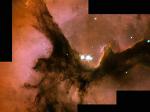 The Trifid Nebula from Hubble
18.06.2004
Clouds of glowing gas mingle with lanes of dark dust in the Trifid Nebula, a star forming region toward the constellation of Sagittarius. In the center, the three huge dark dust lanes that give the Trifid its name all come together.
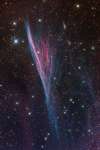 NGC 2736: The Pencil Nebula
8.01.2009
This shock wave plows through space at over 500,000 kilometers per hour. Moving right to left in the beautifully detailed color composite, the thin, braided filaments are actually long ripples in a sheet of glowing gas seen almost edge on. Cataloged as NGC 2736, its narrow appearance suggests its popular name, the Pencil Nebula.
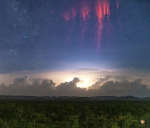 Red Sprite Lightning over Kununurra
25.02.2019
What are those red filaments in the sky? It is a rarely seen form of lightning confirmed only about 30 years ago: red sprites. Recent research has shown that following a powerful positive cloud-to-ground...
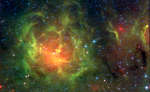 Spitzer s Trifid
13.02.2020
The Trifid Nebula, also known as Messier 20, is easy to find with a small telescope. About 30 light-years across and 5,500 light-years distant it's a popular stop for cosmic tourists in the nebula rich constellation Sagittarius.
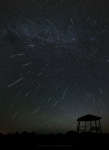 Perseid Outburst at Westmeath Lookout
24.09.2021
This year an outburst of Perseid meteors surprised skywatchers. The reliable meteor shower's peak was predicted for the night of August 12/13. But persistent visual observers in North America were deluged with...
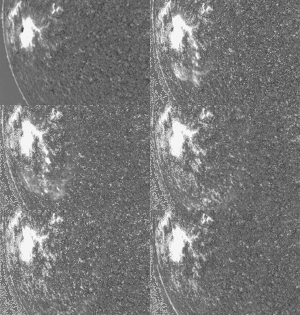 A Large Tsunami Shock Wave on the Sun
22.05.2022
Tsunamis this large don't happen on Earth. During 2006, a large solar flare from an Earth-sized sunspot produced a tsunami-type shock wave that was spectacular even for the Sun. Pictured here, the tsunami...
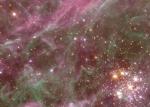 Denizen of the Tarantula Nebula
7.04.1999
The star cluster at lower right, cataloged as Hodge 301, is a denizen of the Tarantula Nebula. An evocative nebula in the southern sky, the sprawling cosmic Tarantula is an energetic star forming region some 168,000 light-years distant in our neighboring galaxy the Large Magellanic Cloud.
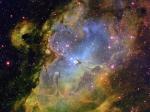 Inside the Eagle Nebula
26.02.2006
From afar, the whole thing looks like an Eagle. A closer look at the Eagle Nebula, however, shows the bright region is actually a window into the center of a larger dark shell of dust. Through this window, a brightly-lit workshop appears where a whole open cluster of stars is being formed.
|
January February March April May June July August September October |
|||||||||||||||||||||||||||||||||||||||||||||||||